



 Goal 17. Partnerships to achieve the Goal
17.3.12 SDG12 Report

2024-2025
1. Ethical Sourcing of Food and Supplies
AASTMT’s Consumption and Recycling Policy commits the Academy to the ethical and responsible sourcing of food and supplies. The item in this section shows how the Academy builds food-safety and quality capability among its suppliers and food-sector partners.
BRCGS Food Safety Global Standard Training Course for Silo Foods
On 11 November 2024, the Productivity and Quality Institute at AASTMT delivered a training course on the BRCGS Food Safety Global Standard — developed by the British Retail Consortium — for Silo Foods Company, led by Dr. Moustafa Elsayed. The course covered food safety, quality and operational requirements for food manufacturers and foodservice organisations, with a focus on hygiene and safety practices that ensure ethical and responsible sourcing throughout the production chain. The BRCGS certification is recognised worldwide as a benchmark for food safety and quality management.
BRCGS Food Safety Global Standard Training for Silo Foods on AASTMT webpage
2. Hazardous Waste Disposal
Hazardous waste from the Academy’s laboratories is segregated, stored and handed to a certified waste-management partner for safe disposal.
Medical Waste Disposal Procedures Within the Arab Academy
During the 2024/2025 academic year, the College of Pharmacy at AASTMT reinforced its commitment to environmental safety by strengthening the hazardous-waste disposal programme in its laboratories. Liquid chemical waste is collected in dedicated bottles in each laboratory before being transferred into larger containers, while broken glass is stored and handled separately. All laboratory hazardous waste is ultimately handed over to Nahdet Misr, AASTMT’s certified waste-management partner, for safe and compliant disposal.
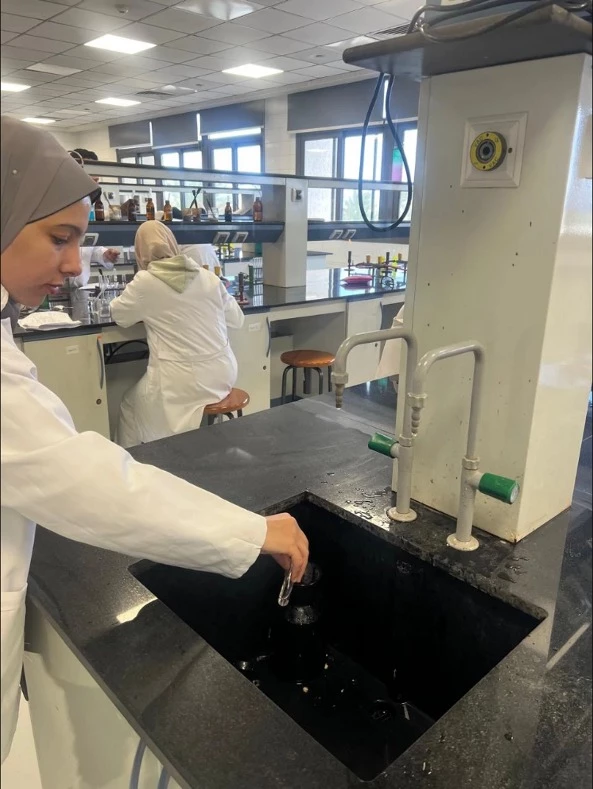
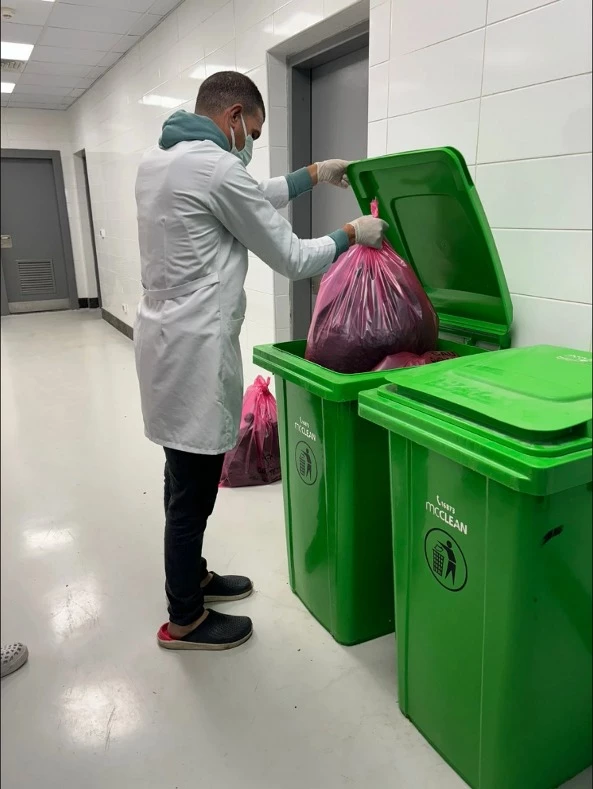
Medical waste disposal procedures within the Arab Academy on AASTMT webpage
3. Organic Waste, Landfill Diversion and Recycling
AASTMT diverts organic waste from landfill through on-campus composting and vermicomposting, recycles agricultural residues into fertilisers, and supports the safe disposal of municipal waste nationally through its role on the committee that supervises and receives Egypt’s sanitary landfill infrastructure.
AASTMT Delivers 23 Sanitary Landfills for Waste Management Across 16 Governorates
In a statement published on 31 October 2024, AASTMT reported on its four-year role (2019–2023) in developing Egypt’s solid waste management system, during which it participated with the relevant ministries in building the infrastructure of the new waste system and in training and qualifying governorate staff to operate, manage and monitor it across collection, transport, treatment and final disposal. The Academy also supported the adaptation of international systems and modern waste technologies to Egyptian conditions and raised awareness among decision makers of global strategies for all waste streams. Its stated aim was to steer national plans towards integrated waste management and to maximise the return on public investment in the sector.
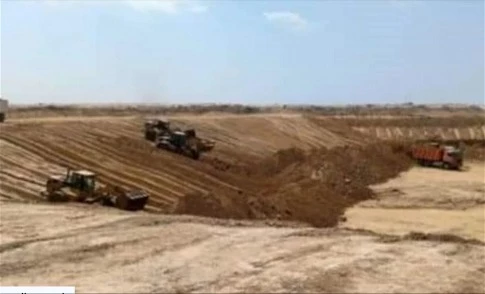
Arab Academy for Sciences Handing over 23 sanitary landfills in 16 governorates on AASTMT webpage
AASTMT Contribution to Egypt’s Solid Waste Management Roadmap – Naval Academy News
4. Minimising the Use of Plastic
These activities reduce plastic consumption and keep plastic waste out of the environment through campus technology, beach and port clean-ups, extended producer responsibility for packaging, and student innovation in recycling.
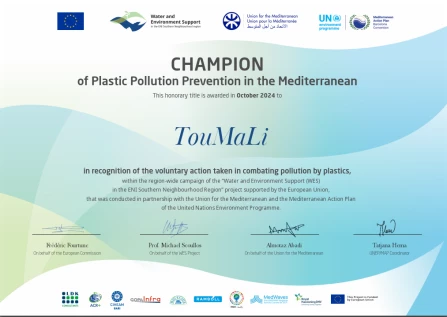
AASTMT’s TouMaLi Project Named “Champion of Plastic Pollution Prevention in the Mediterranean”
In October 2024, the EU-funded TouMaLi project, in which AASTMT is the Egyptian partner, was awarded the honorary title “Champion of Plastic Pollution Prevention in the Mediterranean” in recognition of its voluntary action against plastic pollution. The title was awarded under the regional campaign of the EU-funded Water and Environment Support (WES) project, run in partnership with the Union for the Mediterranean and the Mediterranean Action Plan of the UN Environment Programme. The campaign focuses on reducing single-use plastics and plastic waste in the Mediterranean, and the award recognises the project’s work with the tourism sector, including the hotel waste management and extended producer responsibility activities that AASTMT delivers in Alexandria.
5. Minimising Disposable Items and Promoting Responsible Consumption
Beyond plastics, the Academy encourages reuse and the responsible consumption of water, energy and other resources across its campuses through awareness campaigns, metering, car pooling and community initiatives.
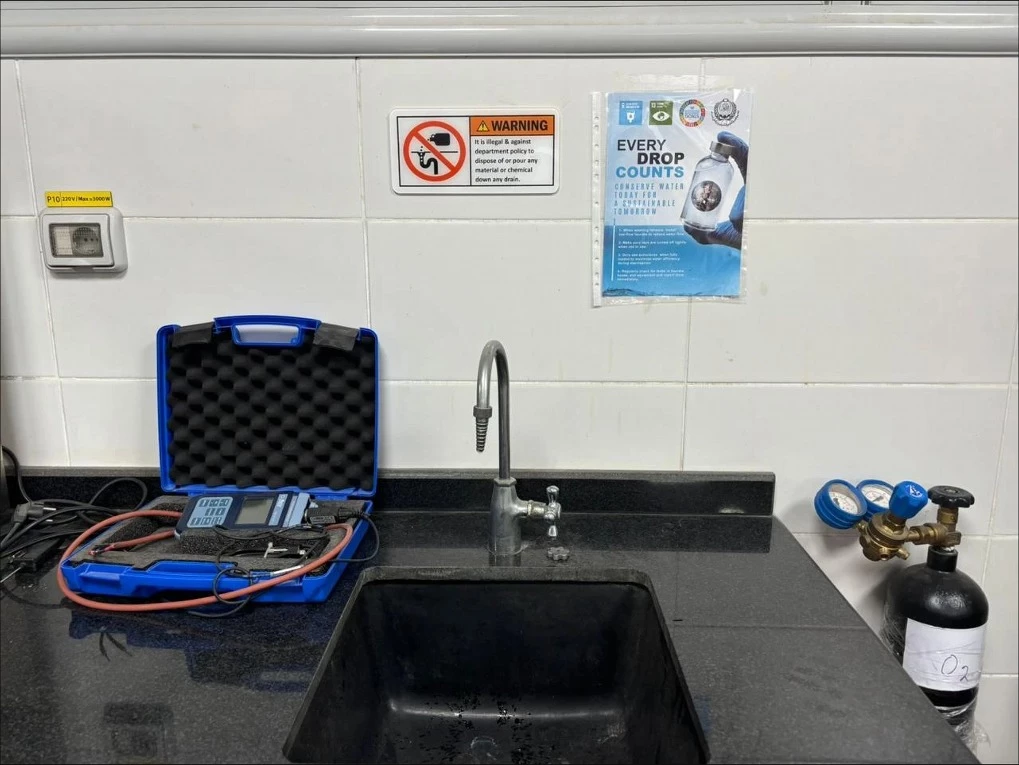
AASTMT Launches the “Every Drop Counts” Conservation Campaign
On 24 October 2024, AASTMT launched the “Every Drop Counts” campaign to promote responsible consumption among students and staff. Awareness posters were placed in teaching laboratories across several departments, reminding users to avoid waste during experiments and in daily use, and placed alongside standing instructions prohibiting the disposal of materials or chemicals down laboratory drains. Faculty members reinforced efficient use, leak reporting and sustainable laboratory practice during practical sessions, embedding minimisation behaviour into everyday campus life.
AASTMT Launches “Every Drop Counts” Water Conservation Campaign on AASTMT webpage
6. Waste Tracking
The Academy measures the waste generated and recycled across its campuses and discloses the figures publicly through its annual UI GreenMetric returns.
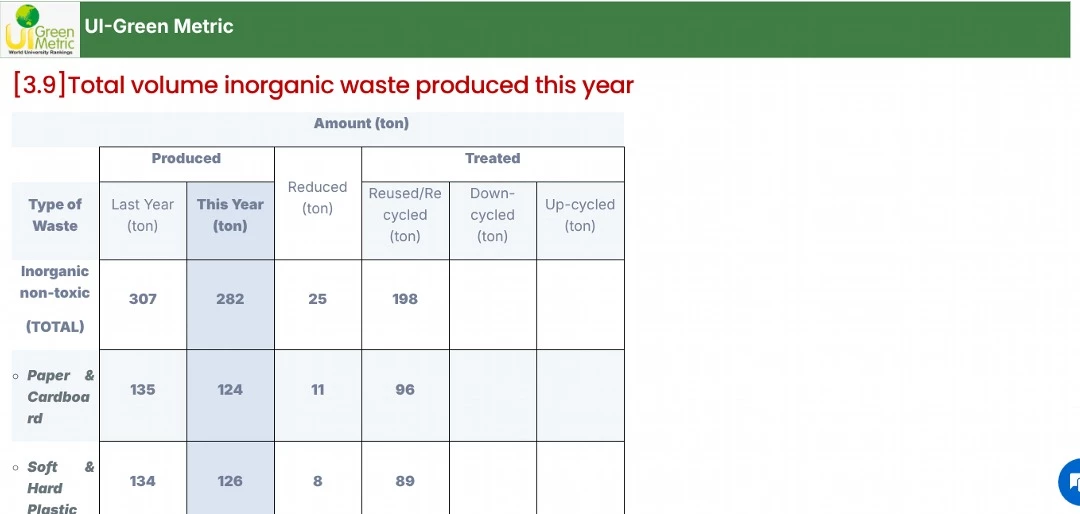
Inorganic Waste Quantities Tracked and Disclosed Through UI GreenMetric
AASTMT continues to measure and publicly disclose the quantities of waste generated and treated across its campuses through its annual UI GreenMetric returns. The most recent reported figures show total inorganic non-toxic waste falling from 307 tonnes to 282 tonnes — a reduction of 25 tonnes, or 8.1% — of which 198 tonnes, 70.2%, were reused or recycled. The figures are broken down by stream: paper and cardboard fell from 135 to 124 tonnes (77.4% treated), soft and hard plastic from 134 to 126 tonnes (70.6% treated), and miscellaneous waste from 38 to 32 tonnes. AASTMT has also introduced an electronic waste recycling programme to ensure obsolete equipment is disposed of sustainably.
[3.9] Total volume inorganic waste produced this year – UI GreenMetric, Sustainable AASTMT
7. Sustainability Reporting and External Disclosure
AASTMT publishes a carbon emissions and sustainability progress report and submits its performance to independent international rankings, allowing stakeholders to verify its progress on waste, resource consumption and emissions.
AASTMT Carbon Emissions Reduction and Sustainability Progress Report (2024)
On 30 April 2025, AASTMT published its Carbon Emissions Reduction and Sustainability Progress Report, a 19-page public document covering performance during 2024 against its 2018–2021 baseline and the preceding 2022–2023 report, and tracking the Academy against its Climate Action Plan milestones of at least a 30% reduction by 2025 and 50% by 2040. On waste, the report records expanded labelled collection points, reinforced operating procedures and term-start refresher briefings for staff and students, with recycling focused on paper, plastics and e-waste routed to approved local facilities and NGO partners, and annual checkpoints used to address bin placement and contamination. It sets a 2030 goal to divert at least 70% of campus waste from landfill and commits to completing a comprehensive recycling assessment and optimisation plan in 2025. These resource measures are linked to a fall of roughly 3% in Scope 3 emissions, to 101,873,000 kg CO₂-e, with total emissions 32.8% below the 2019 base year.
AASTMT Carbon Emissions Reduction and Sustainability Progress Report (2024) – full document
8. Upcoming Goals
Strengthening Circular Economy Practices Across All Campuses
AASTMT aims to expand circular economy models by increasing recycling rates, reducing waste generation at the source, and integrating sustainable materials into campus operations. This will include improved waste segregation, digital tracking of waste streams, and partnerships with industry to convert waste into value-added products. The goal is to create a “zero-waste campus culture” where students, faculty, and staff actively participate in responsible resource use.
Advancing Sustainable Industrial and Research Innovation
AASTMT will continue to invest in research, innovation, and training programs that support eco-efficient production, greener technologies, and responsible industrial practices. New labs, living labs, and applied research projects will focus on waste-to-resource solutions, sustainable manufacturing, and green engineering. Through these initiatives, the Academy seeks to empower students and researchers to design scalable solutions that address national and regional sustainability challenges.
Enhancing Capacity Building and Community Engagement in Sustainable Consumption
AASTMT plans to broaden its sustainability outreach by developing targeted training programs, workshops, and community partnerships that promote responsible consumption and environmental awareness. This includes delivering specialized training on waste management, sustainable consumption behavior, food waste reduction, and eco-friendly lifestyles. The goal is to extend the impact of SDG 12 beyond campus boundaries and build sustainability competencies among youth, professionals, and local communities.
At AASTMT, we are committed to embedding the principle of responsible consumption and production into every facet of our operations, teaching and research. In 2024, we are intensifying our focus on reducing waste, optimizing resource use, advancing circular-economy solutions, and forging partnerships that minimize our environmental footprint. This report presents our progress, initiatives, and institutional strategies aligned with SDG 12—ensuring that we not only educate tomorrow’s leaders but also operate as a sustainable and resource-efficient institution today.