

Introduction
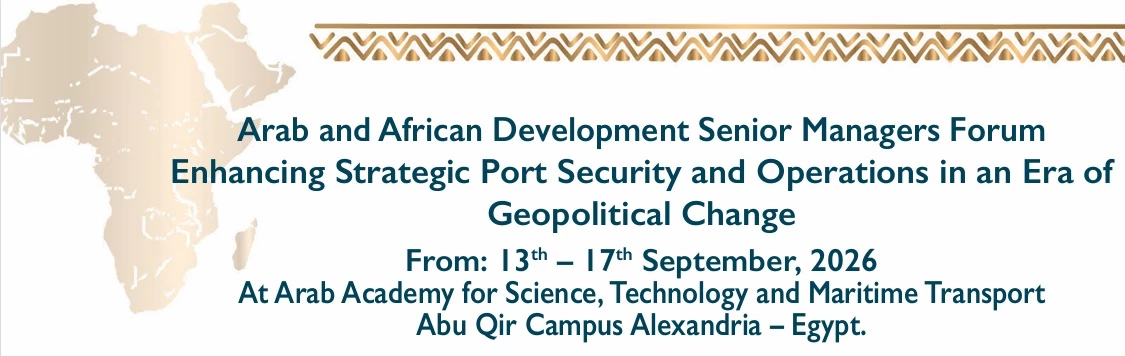
The global maritime industry is undergoing one of the most significant transformations in its history. Seaports are no longer viewed simply as cargo handling facilities; they have evolved into critical, highly connected strategic hubs that support international trade, national security, energy supply, and regional development.
Modern ports operate at the complex intersection of three defining global imperatives: security, digitalization, and sustainability. Recent geopolitical tensions across vital maritime corridors—such as the Red Sea—demonstrate how rapidly regional conflicts can disrupt shipping lines, delay global supply chains, and expose trade routes to acute vulnerabilities. To address these challenges, the forum delivers targeted expertise in core security operations, integrated threat detection, and maritime risk management. Furthermore, it examines how regional economic frameworks—notably the African Continental Free Trade Area (AfCFTA)—can be leveraged to build resilient supply chain networks capable of withstanding global volatility.
Concurrently, the digital transformation of seaports introduces advanced operational capabilities alongside novel cybersecurity risks. As ports deploy smart infrastructure, IoT sensors, and automation, security management must expand beyond physical protection to defend against sophisticated cyber threats that target terminal operations. Through dedicated sessions on smart resilient infrastructure and digital port security safeguards, participants will explore strategies to ensure operational continuity in an increasingly automated environment.
Beyond threat mitigation, modern port governance demands a shift toward environmental stewardship. Sustainable growth requires integrating “green” security practices, championing the blue economy through regional initiatives like StREAM, and aligning port operations with international environmental standards. Grounded by technical tours and actionable benchmarks from Egypt’s Port Development Strategy 2030, this forum equips senior managers with the strategic insights, cross-border partnerships, and operational competencies needed to build secure, resilient, and future-ready maritime infrastructure. In addition, A key highlight of the forum is a field visit to the General Authority for the Suez Canal Economic Zone (SCZone)—offering delegates direct, on-the-ground insights into cutting-edge logistics infrastructure, industrial hub governance, and real-time maritime security measures.
Forum Objective
This forum brings together leading maritime experts to deliver ten specialized sessions designed to equip senior leaders with the strategic tools needed to navigate complex global and regional transport challenges. Over the forum of five days, participants will examine foundational and advanced port security protocols, threat detection methods, and integrated risk management strategies. The curriculum bridges operational resilience with macro-level socio-economic drivers by addressing supply chain vulnerabilities amid geopolitical shifts, the critical role of key shipping corridors, and trade facilitation under the African Continental Free Trade Area (AfCFTA). Furthermore, the program highlights forward-looking technological and environmental advancements—including smart resilient infrastructure, digital port security safeguards, the RED SEA 2030 StREAM Initiative for the sustainable blue economy, and “green” security frameworks—culminating in an in-depth benchmark analysis of Egypt’s Port Development Strate 2030.
Training Methodology
The training program includes:
✤Interactive lectures
✤Case studies
✤Group discussions
✤Risk assessment exercises
Target Participants
This training program is designed for:
1. Port Security Managers
2. Port Facility Security Officers
3. Maritime Safety Officers
4. Terminal Operators
5. Risk Managers
6. Port Authority Officials