
Nowadays, Africa has become the most interesting destination for investors from all over the globe including Africa, US, EU and the BRIC (Brazil, Russia, India and China) countries, among others. International trade and investment are often considered as two sides of the same coin. Africa is a market of 1.2 billion people, and more than 70% of the world’s largest consumer goods companies are already operating in Africa. The Intra-Africa trade presents opportunities for sustained growth and development in Africa. However, in order to achieve regional integration and boost Intra-Africa trade, African countries have to adapt rapidly to the changing needs and requirements.
Africa has the potential to contribute to economic diversification, enhance export competitiveness, reduce vulnerability to global shocks, and offer more chances for employment. In addition, blue economy in Africa is still underexploited, despite the fact that it can offer a range of solutions to many economic problems. Moreover, blue economy is considered as a catalyst for investments in Africa. The wealth that can be generated from the ocean is conservatively valued at US$ 24 trillion, of which it is estimated that goods and services provide $2.5 trillion annually.
On the other hand, the weak regional trade performance in Africa can be attributed to a variety of constraints. These constraints include inadequate infrastructure, low productivity capacity, limited trade financing tools, weak human and institutional capacities and weak trade facilitation. However, the three biggest obstacles hindering doing business in Africa are liquidity, infrastructure and corruption.
Africa’s future growth and development depend on the quality of its infrastructure and the efficiency of its transport networks. Infrastructure insufficiencies play a major role in hindering Africa from fully reaching its potential– trade and growth. Furthermore, Africa needs infrastructure investment of between $130 billion and $170 billion per year. Consequently, it is estimated that by 2050, trade will be boosted by improvements in logistics.
The operating environment, where logistics play an important role, is very critical for transport and trade. Logistics investments include the allocation of capital to improve the efficiency of freight distribution through: Infrastructures, such as terminals, real estate, and telecommunications; Operations, including transport modes and equipment, and Human resources related to labor, management, and governance, as well as research and development. The outcomes of investing in logistics capabilities are numerous, but are mainly increased integration with global trade and supply chains, better utilization of national transport assets, more competitive exports, and lower cost for imports, as well as increased employment opportunities. Henceforth, there is a need for financial resources to transform Africa’s natural resources.
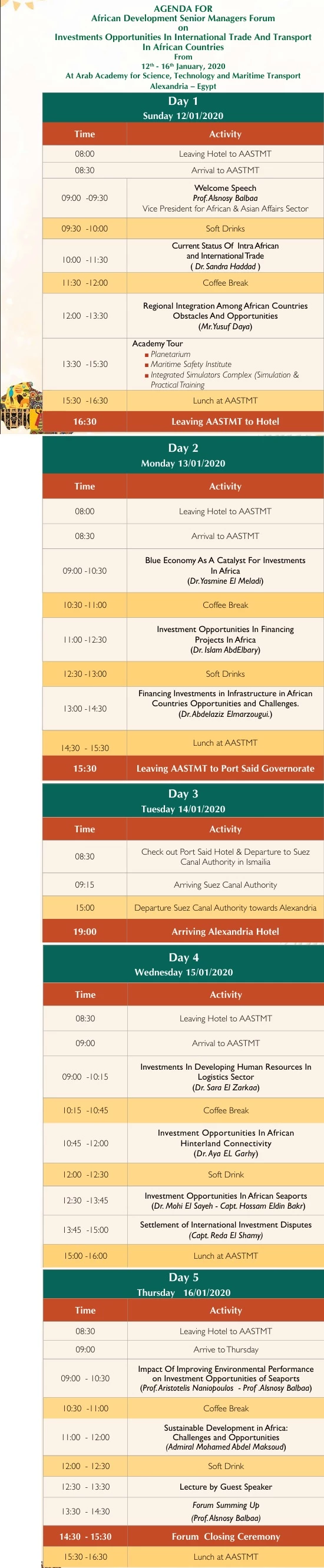
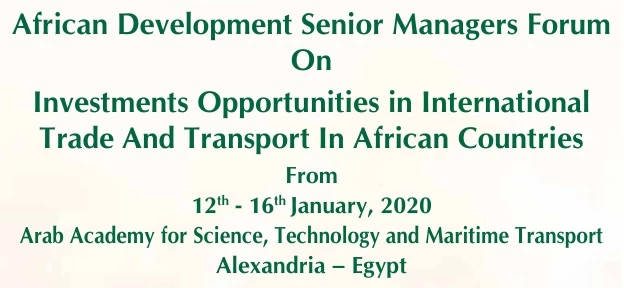
The aim of the current Forum is to analyze the challenges and obstacles that hinder trade among African countries and that complicate doing business. In addition, great attention is devoted to the investment opportunities in transport and seaports to improve and enhance intra-Africa Trade.