




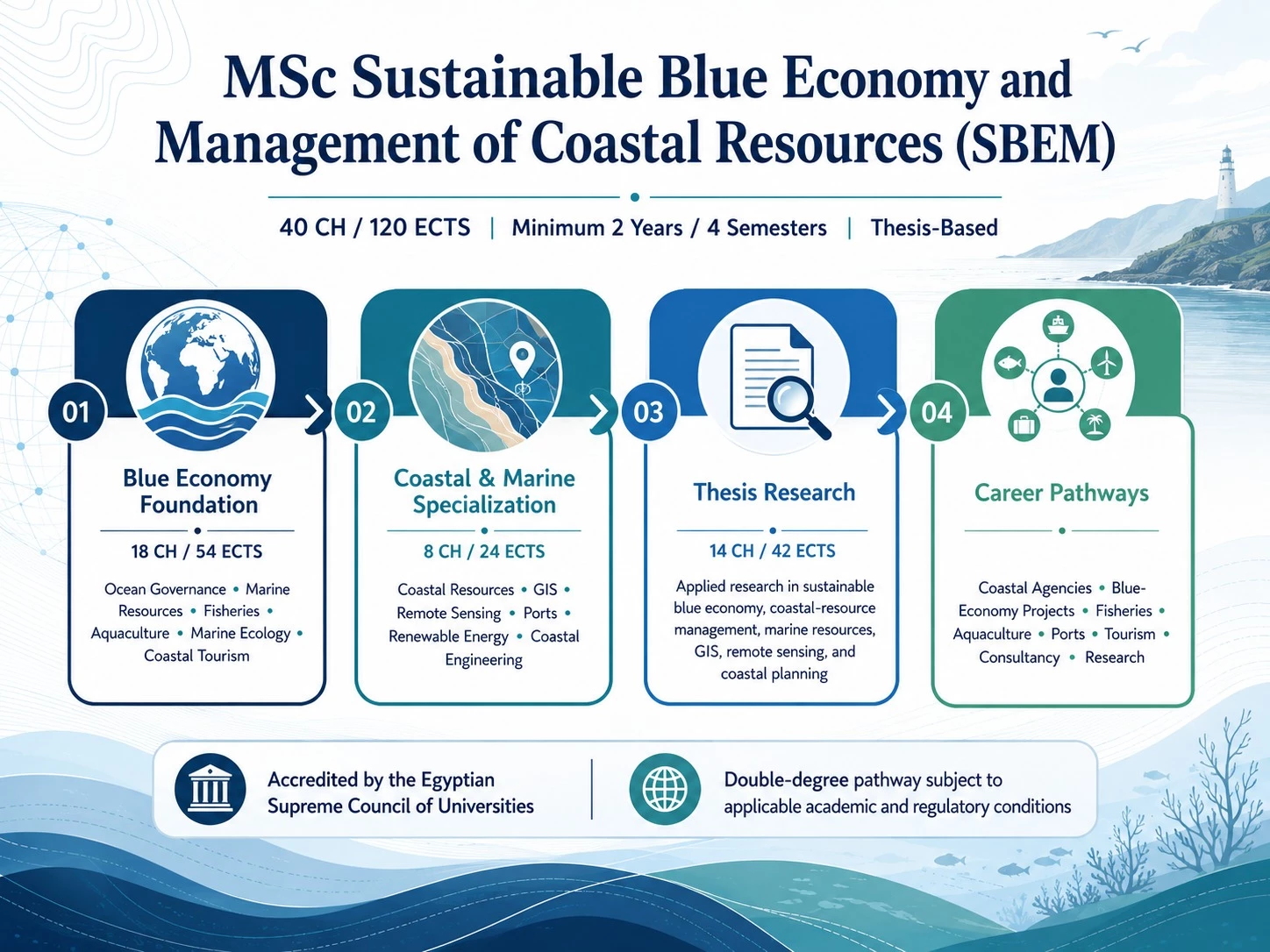
The Master of Science Degree in Sustainable Blue Economy and Management of Coastal Resources (SBEM) is a thesis-based postgraduate program focused on sustainable blue economy, coastal-resource management, marine living and non-living resources, fisheries, aquaculture, ocean governance, coastal tourism, marine ecology, GIS, remote sensing, ports, and sustainability.
The program prepares graduates to support sustainable use of marine and coastal resources and to contribute to blue-economy development through applied research, planning, and professional practice.
|
Item |
Details |
|
Degree title |
Master of Science Degree in Sustainable Blue Economy and Management of Coastal Resources |
|
Short name |
MSc SBEM |
|
Level |
Master of Science |
|
Duration |
Minimum 2 years / 4 semesters |
|
Total load |
40 CH / 120 ECTS |
|
Coursework |
26 CH / 78 ECTS |
|
Research component |
14 CH / 42 ECTS thesis |
|
Language of study |
English |
|
Awarding institution |
Arab Academy for Science, Technology and Maritime Transport (AASTMT) |
|
Awarding institute |
Maritime Postgraduate Studies Institute (MPI) |
|
Campus |
Abu Qir Campus, Alexandria, Egypt |
|
International pathway |
Double-degree pathway, subject to applicable academic and regulatory conditions |
The program aims to:
Graduates of the program are expected to be able to:
This program is suitable for graduates and professionals interested in sustainable blue economy, marine and coastal resources, fisheries, aquaculture, maritime governance, coastal tourism, marine ecology, GIS, remote sensing, sustainability, ports, and coastal development.
Full admission requirements are available under the Admissions section.
|
Component |
Load |
|
Compulsory courses |
18 CH / 54 ECTS |
|
Elective courses |
8 CH / 24 ECTS |
|
Thesis |
14 CH / 42 ECTS |
|
Total |
40 CH / 120 ECTS |
|
Code |
Course |
|
MPI676 |
International Maritime Law and Ocean Governance |
|
MPI675 |
Blue Resources for a Sustainable Blue Economy: Non-Living Resources |
|
MPI678 |
Applications for GIS and Remote Sensing in Marine and Coastal Environments |
|
MPI674 |
Blue Economy and Sustainable Use of Marine Bioresources: Fisheries and Aquaculture |
|
MPI679 |
Oceanography and Climate Change |
|
MPI673 |
Blue Economy, Innovation and Entrepreneurship |
|
MPI677 |
Marine Ecology, Biotechnology |
|
MPI672 |
Coastal Tourism and the Blue Economy |
|
MPI670 |
Research Methodology |
Students select elective courses from approved blue-economy and coastal-resource fields, including:
The program includes a 14-credit-hour thesis focused on applied research in sustainable blue economy, coastal-resource management, marine resources, environmental sustainability, GIS, remote sensing, coastal planning, or related fields.
Graduates may pursue academic, professional, or research roles in:
MSc SBEM is accredited by the Egyptian Supreme Council of Universities.
Apply / Download Brochure / Contact
Apply Now
Download Program Brochure
Contact MPI
Link targets:
