

AASTMT includes planting in the planning and design of its building projects. In academic year 2024–2025 it repurposed the hall attached to the Presidency building at its Abu Qir campus in Alexandria; the design added planting basins across the site and inside the building and linked the building to the green areas around it. The project is recorded in the standards that AASTMT’s Engineering Administrations follow when designing, building and maintaining buildings, issued by the Construction Administration in November 2025, which also record earlier projects designed in the same way. The AASTMT Environmental Sustainability Policy, as published during 2025, committed the Academy to develop green spaces on campus that support native flora and fauna.
Repurposed Presidency hall, Abu Qir campus
A new student space with planting inside and around the building
construction 2024/2025, Abu Qir campus, Alexandria
AASTMT repurposed the hall attached to its Presidency building at Abu Qir to create the Think Tank, a gathering space for students. The project repurposed part of an existing building. Planting basins were designed across the general site and inside the building, in the main corridors and around the main staircase patio. A modern metal canopy over the entrance gives students shade and links the building in form and function to the green areas around it.
The project is also recorded in the AASTMT Biodiversity Action Plan and Campus Development Plan 2025–2030, Section 11.1 (Documented Practice: Campus land and green space), as the Presidency annex hall (“Think Tank”), Abu Qir, built 2024/2025: the repurposing of the hall attached to the Presidency building, with many planting basins in the surrounding site and in the main corridors and staircase patio. The plan describes these as greening features of the design and requires a biodiversity survey before design for future projects under Section 8.
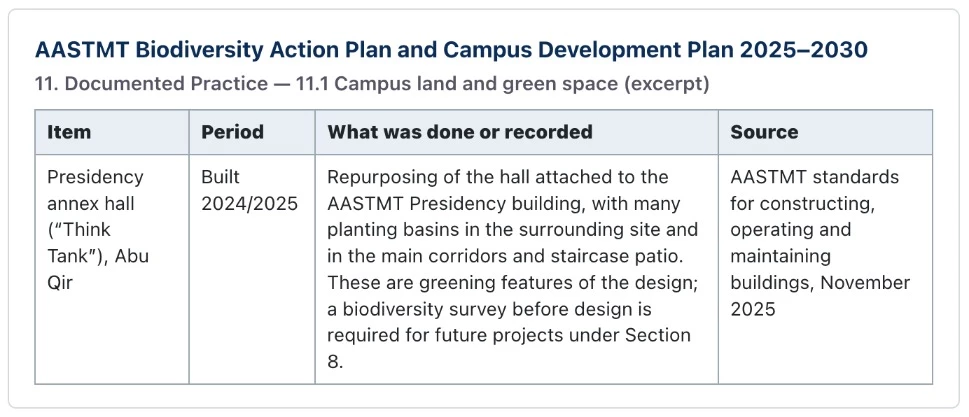
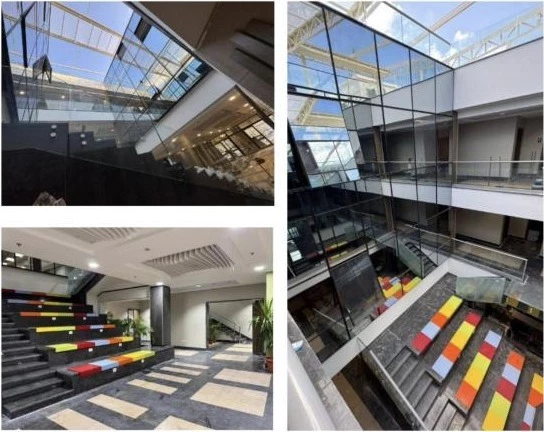 | 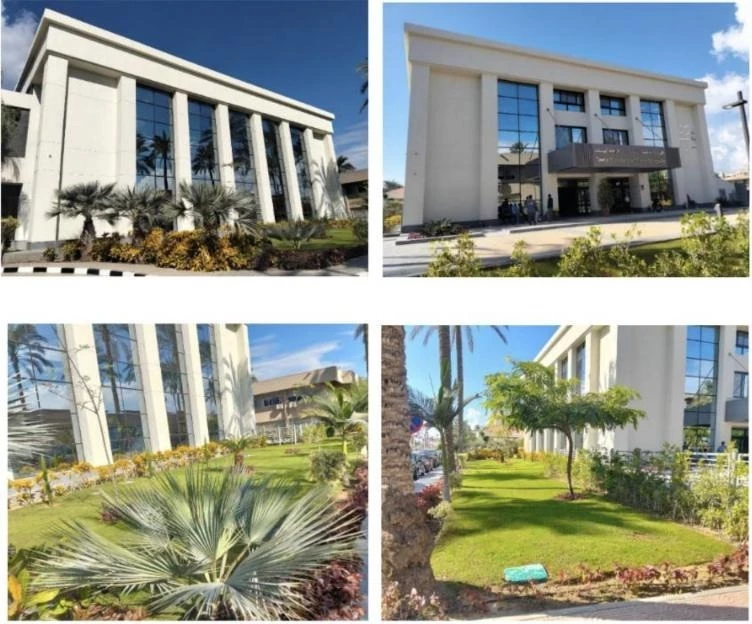 |
Environmental Sustainability Policy
Green spaces that support native flora and fauna
AASTMT Environmental Sustainability Policy, as published during 2025, last review 2025
The AASTMT Environmental Sustainability Policy published on the AASTMT ESG website, whose review table records its creation in January 2019, approval by the SDGs Workforce Committee and a last review in 2025, commits AASTMT to “develop green spaces on campus to support native flora and fauna; implement eco-friendly landscaping practices”, to develop a campus-specific biodiversity and green space plan for each branch, and to develop a Green Campus physical infrastructure roadmap for each campus addressing “expansion of green and permeable surfaces, native planting and campus biodiversity corridors”.
Planting and local plants in every project
Construction Administration standards, issued November 2025, all AASTMT campuses
AASTMT’s Engineering Administrations design and carry out construction and development work on its campuses. Their standards, issued by the Construction Administration in November 2025 and published in Arabic on the AASTMT website, require that this work reduces the impact of buildings on the environment. For the land around each building, the standards require:
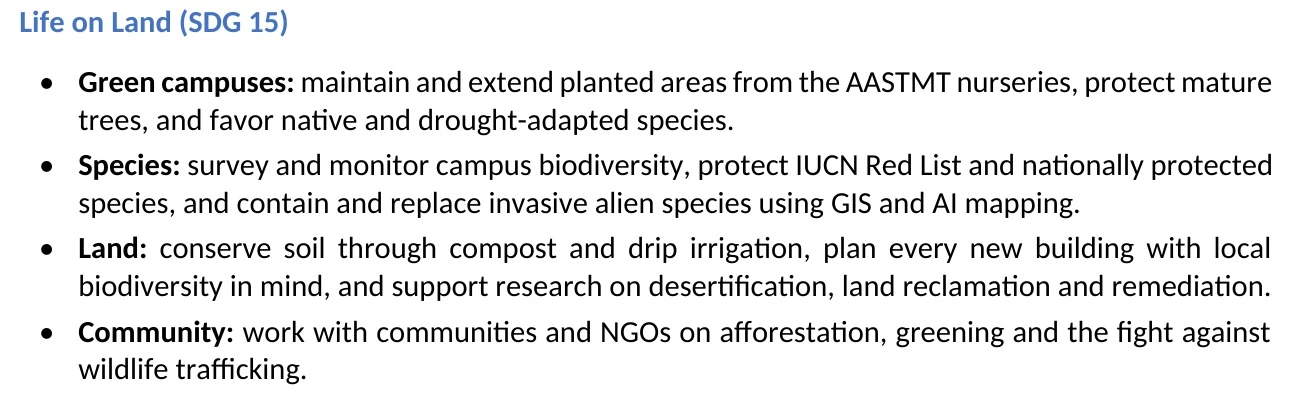
Every new building planned with local biodiversity in mind
AASTMT Environmental Sustainability Policy, Version 6, October 2026
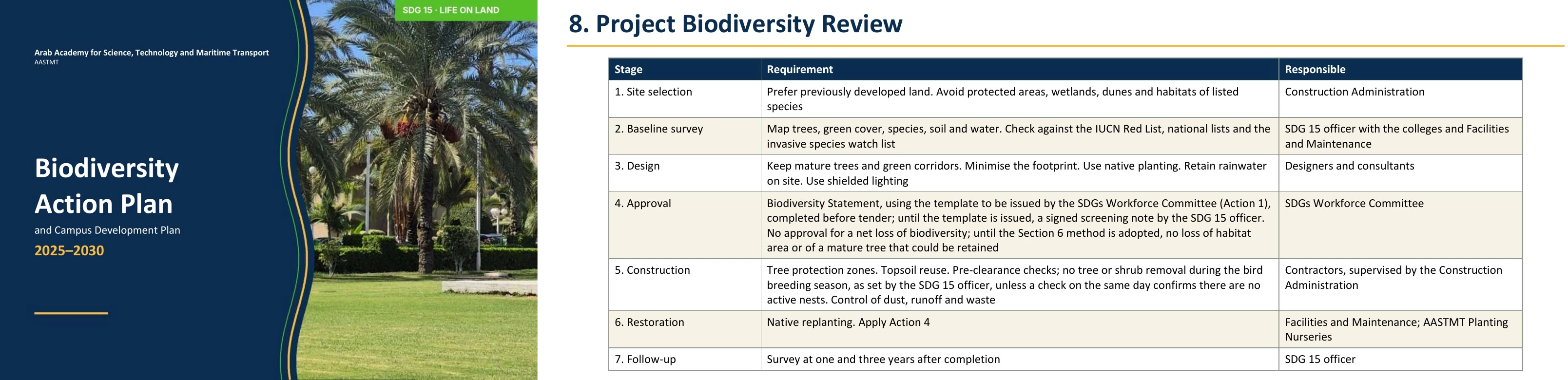
Project biodiversity review
AASTMT Biodiversity Action Plan and Campus Development Plan 2025–2030, Section 8, published November 2026
The AASTMT Biodiversity Action Plan and Campus Development Plan 2025–2030, published on the AASTMT website, sets a biodiversity review for every qualifying project from November 2026: site selection on previously developed land, a baseline survey checked against the IUCN Red List, design that keeps mature trees and uses native planting, a Biodiversity Statement approved before tender, construction safeguards, native replanting, and follow-up surveys one and three years after completion.
AASTMT includes local biodiversity in the planning and development of its campuses. The AASTMT Environmental Sustainability Policy requires every new building to be planned with local biodiversity in mind. In 2024–2025 the Engineering Administrations applied this in the repurposed hall of the Presidency building at Abu Qir, which added planting basins inside and around the building. The standards they follow when designing, building and maintaining buildings on every campus, issued by the Construction Administration in November 2025, formalise this practice: they require many planting basins in the general site of each project, the use of all vacant land around buildings for trees, shrubs and local plants, and irrigation and drainage that serve planted areas.
AASTMT’s Engineering Administrations design and carry out all construction and development work on its campuses. Their standards, issued by the Construction Administration in November 2025 and published in Arabic on the AASTMT website, require that this work reduces the impact of buildings on the environment. For the land around each building, the standards require:
• the design of many planting basins across the general site, which also reduces the heat-island effect;
• the use of all vacant areas of the general site to increase plantings, flower beds, trees, shrubs and local plants;
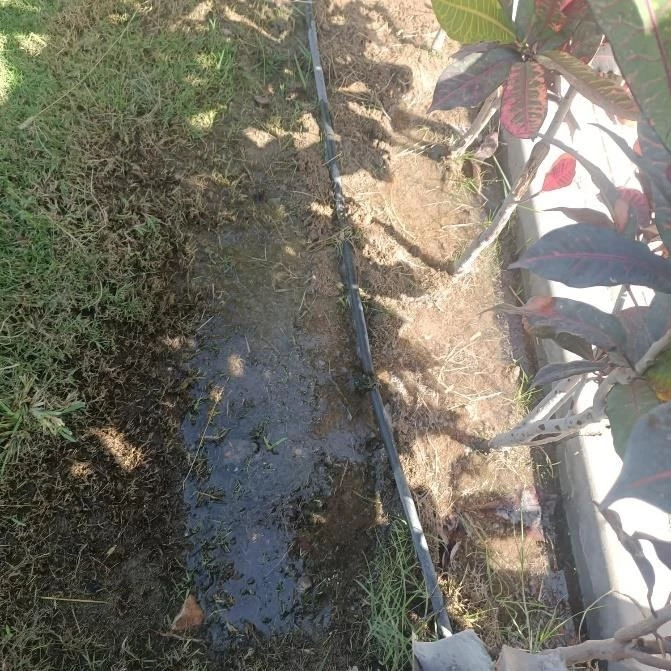
• perforated-pipe irrigation in planting basins whenever the site around a project is modified, instead of flood irrigation with drinking water;
• open drainage that carries rainwater from roofs and walkways into planting basins and green areas, and drains in paved areas that let rainwater soak into the soil to recharge the natural groundwater;
• irrigation of green areas with groundwater from deep wells, tested regularly to confirm it is suitable;
• a phased replacement of building and site lighting with LED, to limit the effect of building lights, reduce night glare and reduce light pollution.
The document records recent projects that applied these standards on the South Valley (Aswan) and Abu Qir campuses, with photographs.
This report outlines AASTMT’s engineering approach to constructing, operating, and maintaining buildings according to sustainability standards across all campuses. It highlights the use of passive design strategies, renewable energy systems, water-saving technologies, and energy-efficient HVAC and lighting. The document also showcases actions to reduce heat islands, improve natural ventilation, and expand green landscapes using native vegetation. Sustainable site management practices—such as groundwater use, rainwater infiltration, recycling, and waste reduction—are emphasized. The report includes documented projects (2015–2025) showing the application of these sustainability criteria in real AASTMT facilities.
In a “Fundamental Principles” document, AASTMT states its commitment to protect, restore, and sustainably use terrestrial ecosystems and biodiversity.

As part of its commitment to environmental sustainability, AASTMT builds on brownfield sites to minimize the need for new land conversion and to protect natural habitats. This strategy encourages prudent land use while reducing the environmental impact of campus construction
Building on brownfield sites on AASTMT web page
The Ministry of Housing, Utilities, and Urban Communities in Egypt is hosting the Seventh Arab Housing Conference, under the title “Towards Smart Sustainable Cities that Achieve Quality of Life,” from December 18 to 20, 2022, in the New Administrative Capital. The organizing bodies include the Ministry of Housing, the Council of Arab Ministers of Housing and Construction, and the League of Arab States. The conference aims to present joint Arab visions to confront urban challenges in the Arab world and provide innovative solutions and effective mechanisms. The professor called Dr. Ismail Abdel Ghaffar: Faculty members and researchers wishing to participate by submitting the required papers for the competition.
Arab Housing Conference on AASTMT web page
The training course in “Quality Control in Construction” provided by the Cairo and Alexandria branches of the Arab Academy for Science, Technology, and Maritime Transport (AASTMT) aims to introduce students to the basic principles of quality control in the field of construction. Course contents include quality improvement techniques, variable element diagramming, and evaluation of concrete strength test results.
Construction and building Management Courses
Environmental Management System (EMS) and Energy Management System (EnMS) help sustainable businesses and help to reduce an organization’s impact on the environment while improving operating efficiency, controlling, and reducing your organization's energy consumption, which reflects on reducing product manufacturing costs as energy costs rise.
Energy and Environmental Management Courses
Renewable Energy and Sustainable Development (RESD) is a biannual international peer-reviewed journal that presents a global forum for dissemination of research articles, case studies, and reviews focusing on all aspects of renewable energy and its role in sustainable development. The topics of focal interest to RESD include, but are not limited to, all aspects of wind energy, wave/tidal energy, solar energy, as well as energy from biomass and biofuel.
Dissemination of research articles
Du-IECRI 2024 aims to present engineering research and innovation that support the great projects that serve the objectives of the sustainable strategic plan, Egypt Vision 2030.
International Engineering conference on Research and Innovation on AASTMT web page


