
Download the full report (PDF)
Arab Academy for Science, Technology and Maritime Transport
Living Campuses
Biodiversity at AASTMT, 2024–2025
How the Arab Academy grows, protects and studies life on land, from the Abu Qir Campus on the Mediterranean to the South Valley Campus in Aswan.
Abu Qir Campus · Heliopolis Campus · Smart Village Campus · El Alamein Campus · Port Said Campus · South Valley Campus, Aswan
Welcome
Egypt is one of the driest countries on Earth, and every tree, hedge and garden here depends on careful hands and scarce water. For more than a decade, the Arab Academy for Science, Technology and Maritime Transport (AASTMT) has looked after the plants and wildlife of its campuses, raised its own seedlings, and turned its research towards the conservation and restoration of Egypt’s land, coasts and wetlands.
At a glance
|
8 campuses in 6 Egyptian governorates |
213,646 m² AASTMT Abu Qir Campus, the main campus |
62,000 m² planted vegetation at the Abu Qir Campus, about 30% of the campus |
2 nursery inspections by the AASTMT President at the Abu Qir Campus (13 May 2024, 12 May 2025) |
|---|---|---|---|
|
13 borehole wells that irrigate every green area at the Abu Qir Campus |
6 days UniGreen climate bootcamp at the Abu Qir Campus (May 2024) |
4,765 m² of planted green walls at the South Valley Campus, Aswan |
5 South Valley Campus studies on trees, green walls and desert land published in 2024–2025 |
01 · Grow · Protect · Discover · Share
Four simple ideas guide our work on biodiversity across every campus.
|
Grow We raise plants in our own nurseries at the Abu Qir Campus and use them to extend the green cover of our campuses, adding trees, hedges, green walls and green roofs where space is tight. |
Protect We care for mature trees, conserve soil and water, watch for invasive plants and favour species that suit Egypt’s coastal and desert climate. |
|---|---|
|
Discover Our colleges study Egypt’s ecosystems, from Red Sea mangrove forests and coastal wetlands to the deserts of Aswan, and test ways to restore them. |
Share We plant, learn and celebrate with students, schools, government and partners, every World Environment Day and throughout the year. |
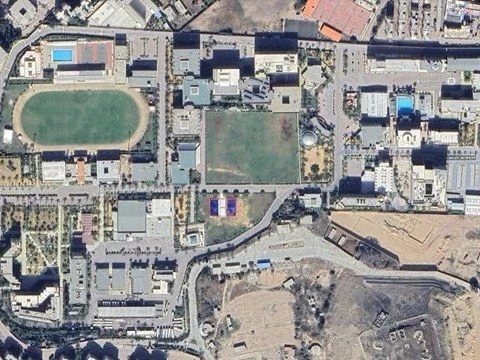
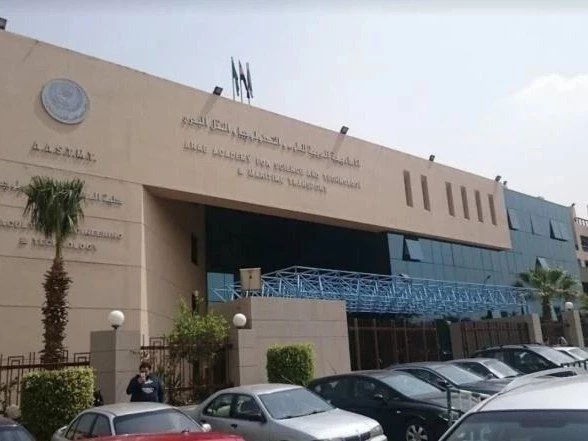
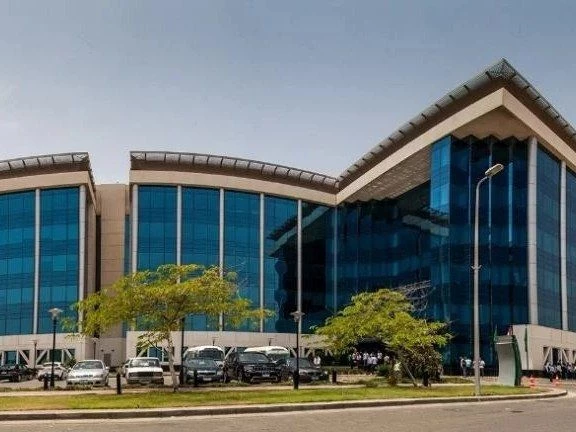
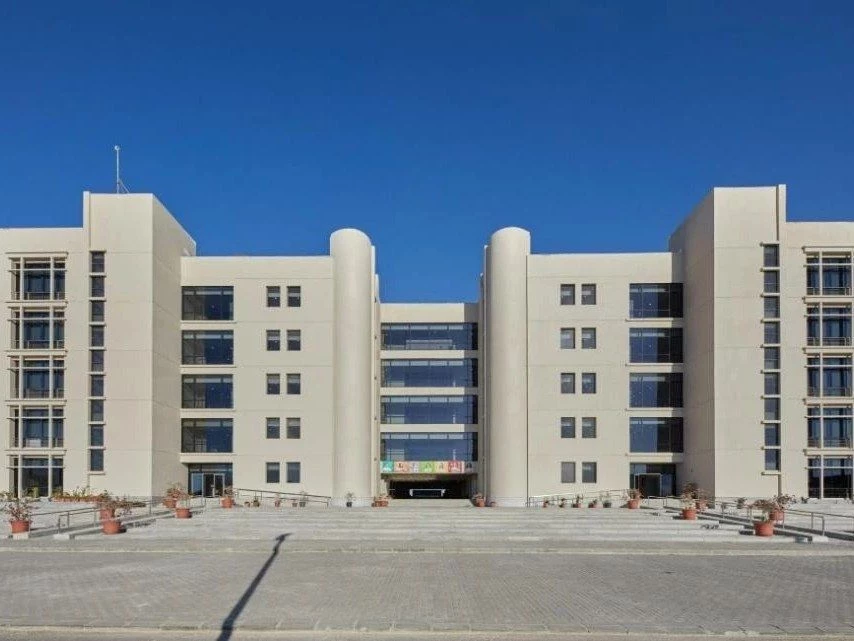
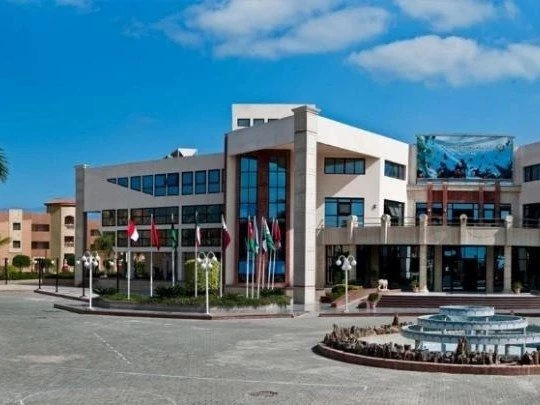
AASTMT teaches and researches on 8 campuses in 6 Egyptian governorates, each in a different landscape: the Mediterranean coast at the Abu Qir, El Alamein and Port Said campuses, the desert edge of greater Cairo at the Smart Village and Heliopolis campuses, and the Nile Valley at the South Valley Campus in Aswan.
 |
 |
 |
|---|---|---|
| Abu Qir Campus Main campus on the Mediterranean |
Heliopolis Campus Urban campus in the capital |
Smart Village Campus Desert edge west of Cairo |
 |
 |
 |
| El Alamein Campus Coastal desert of the North Coast |
Port Said Campus Between the Suez Canal and Lake Manzala |
South Valley Campus Hot desert of the Nile Valley |
02 · Timeline
From the planting nurseries of the Abu Qir Campus to research on greening the desert at the South Valley Campus, these are the dated milestones of 2024 and 2025.
| 3 May 2024 | UniGreen bootcamp turns local ideas into climate and land-restoration businesses | Abu Qir Campus |
|---|---|---|
| 10 May 2024 | Study shows which trees and grass best cool the El-Khazzan district of Aswan | South Valley Campus |
| 13 May 2024 | Planting nurseries inspected by the AASTMT President as green areas expand | Abu Qir Campus |
| 30 Jul 2024 | Blue carbon measured in grey mangrove forests on the Red Sea coast | Abu Qir Campus |
| 1 Sep 2024 | Plan to reclaim desert land in Wadi Dihmit, Aswan | South Valley Campus |
| 23 Sep 2024 | Cooperation protocol with MAFI for Agricultural Produce Industries | Heliopolis Campus |
| 12 May 2025 | Nurseries present new methods for plant maintenance and irrigation | Abu Qir Campus |
| Sep 2025 | Green walls keep Aswan homes up to 6 °C cooler on a 45 °C day | South Valley Campus |
03 · Abu Qir Campus · main campus since 1972
Our oldest and largest campus faces the Mediterranean at Abu Qir. Almost a third of it is planted: lawns, palms, shade trees, hedges and flower beds that shelter birds and insects and cool the campus in summer.
|
213,646 m² total campus area (about 53 acres) |
62,000 m² planted vegetation (about 30%) |
45% of the campus is open space |
13 borehole wells for irrigation |
|---|
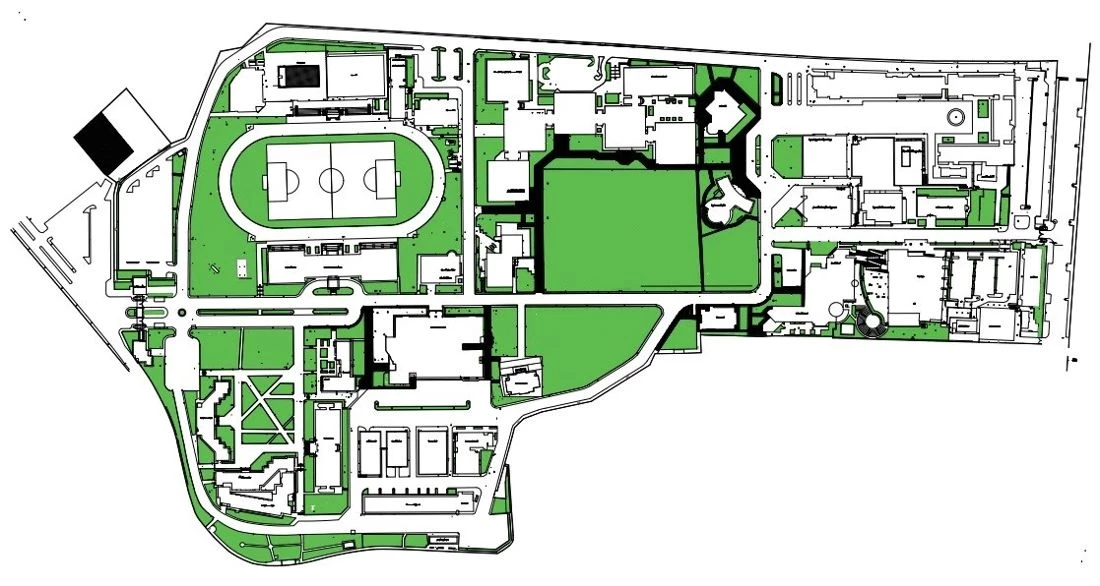
Planted vegetation (green) across the Abu Qir Campus.
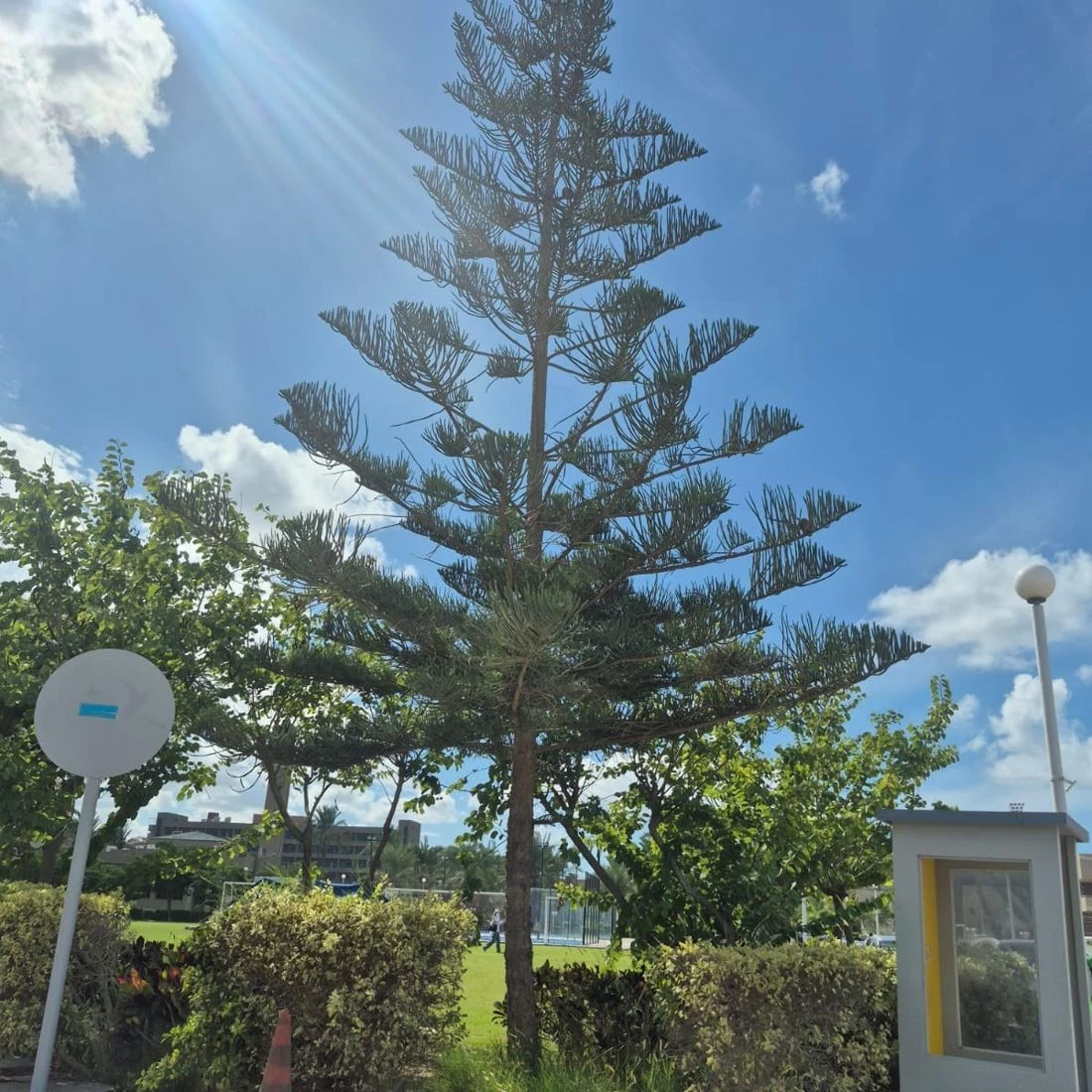
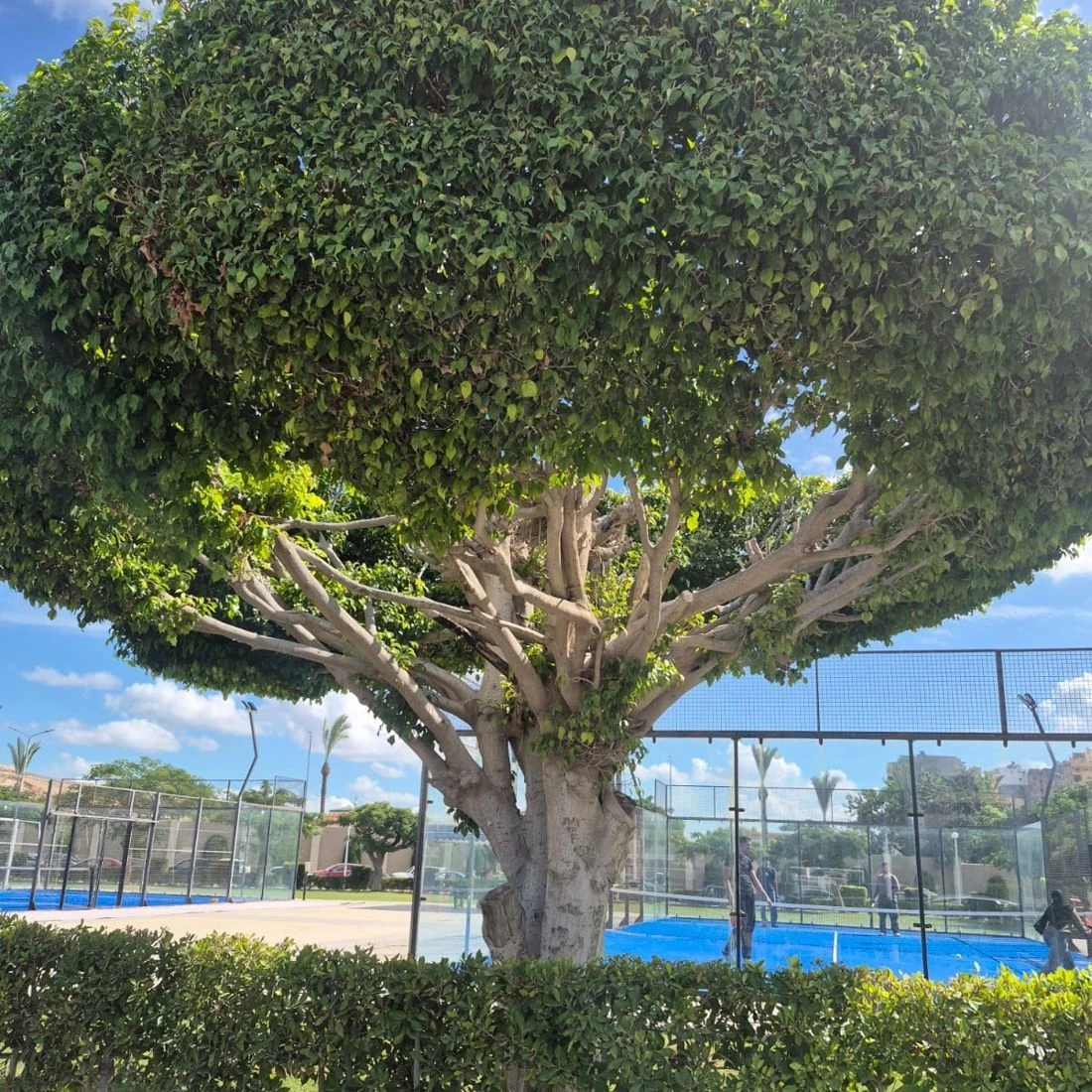
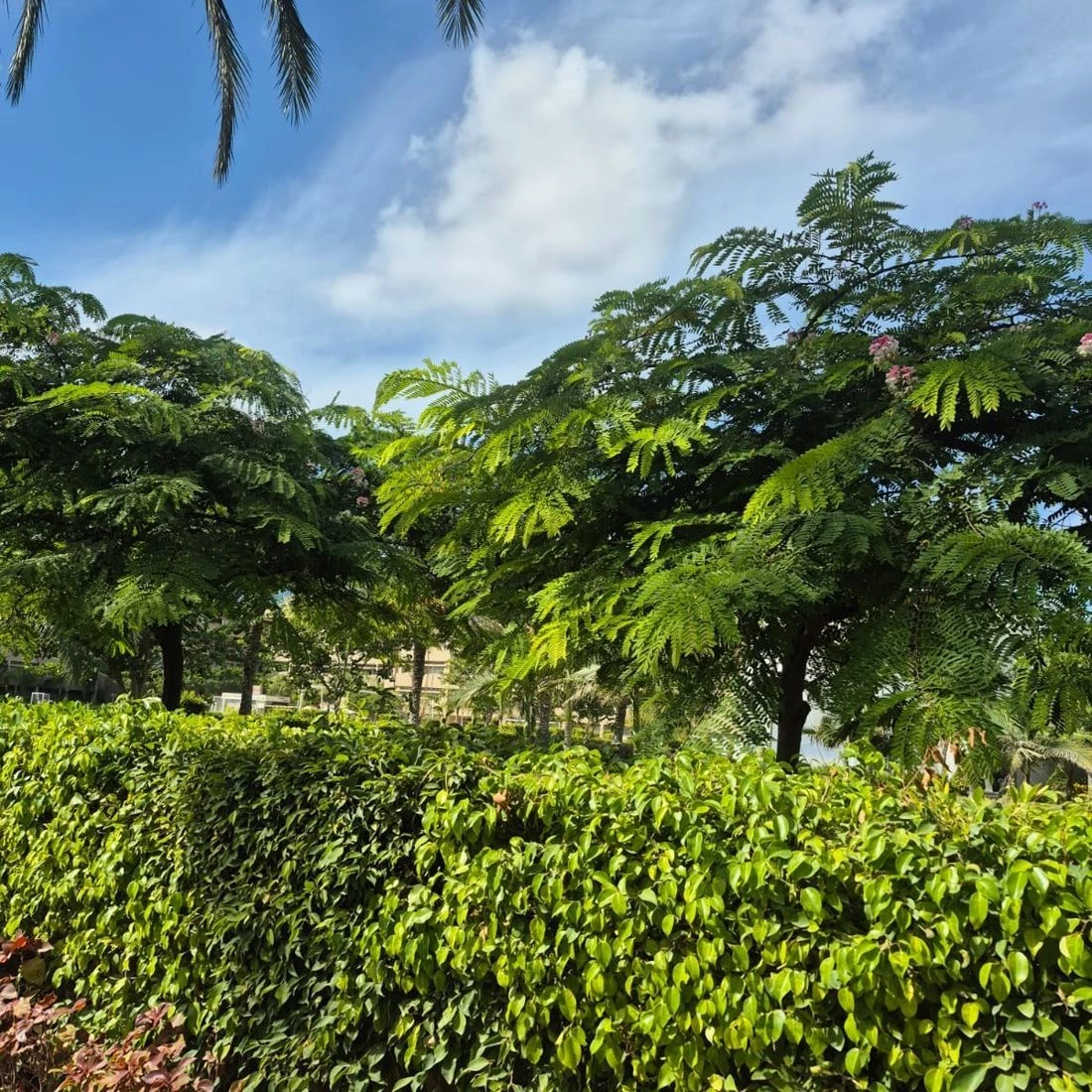
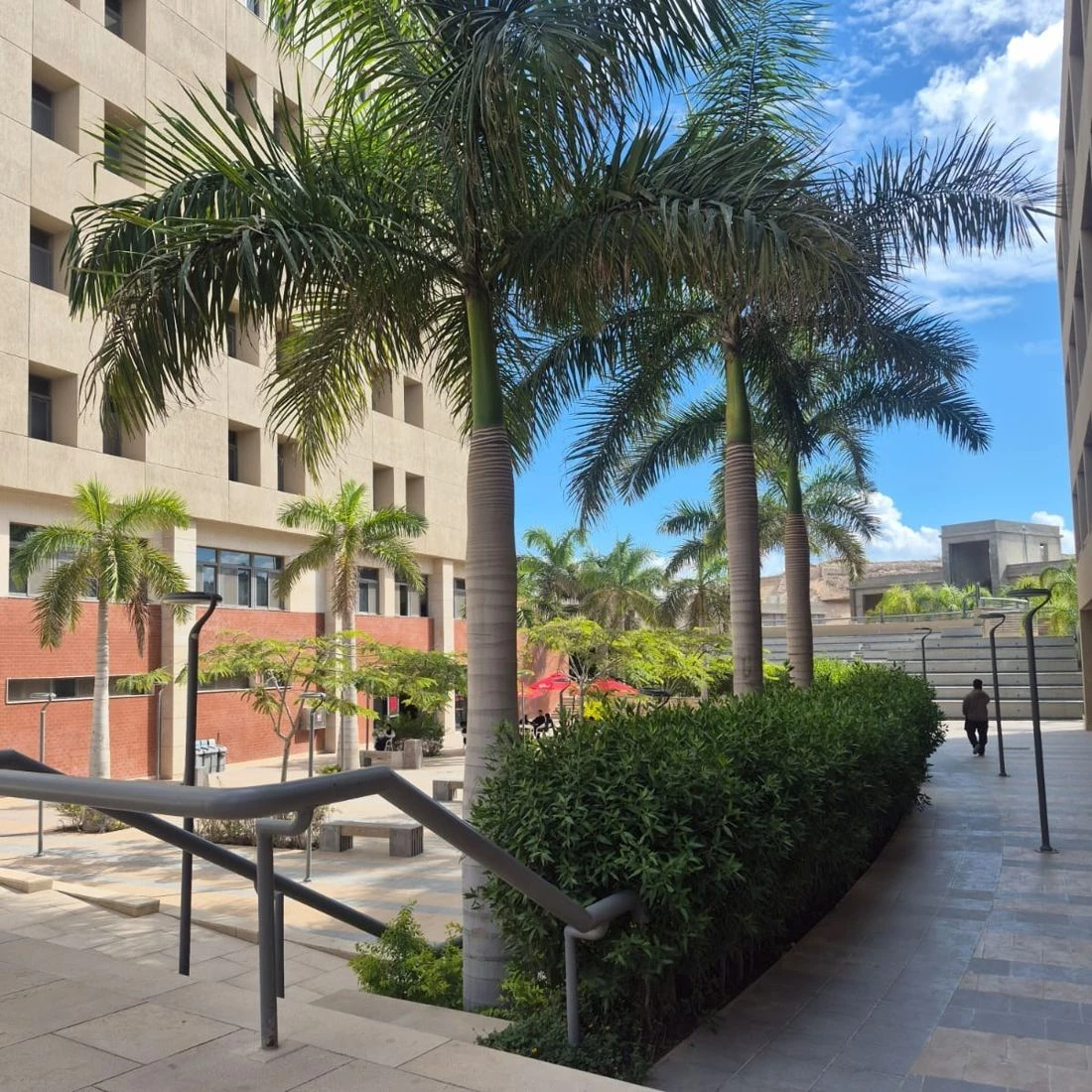
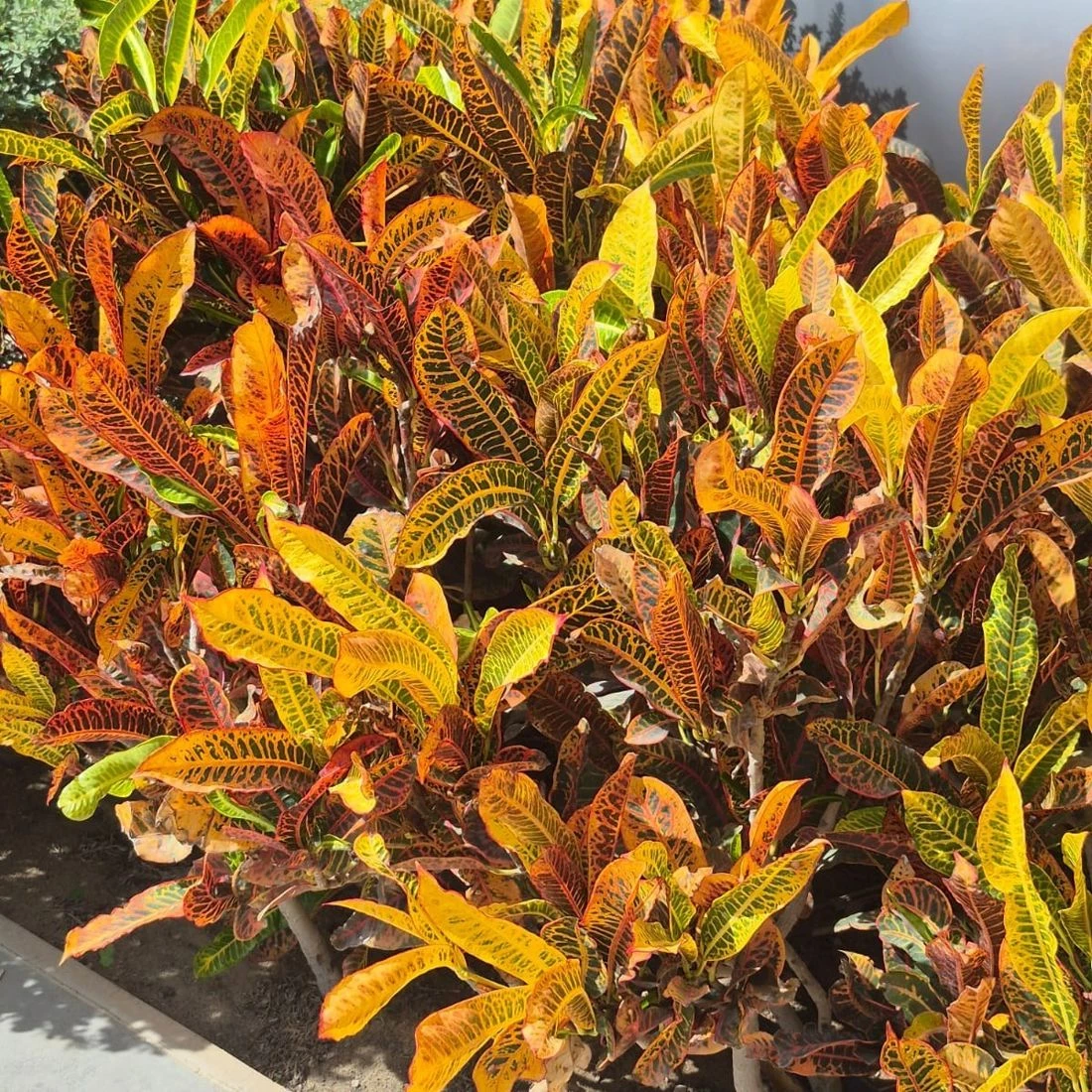
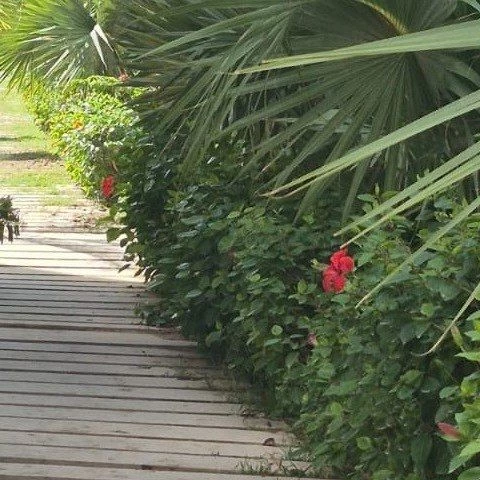
The campus vegetation is built in layers, each with its own role for wildlife and climate. Tall date palms, royal palms and fan palms form the upper storey; broad shade trees such as the rain tree and ornamental figs give dense canopy; clipped hedges of oleander and other shrubs line the walkways; and flower beds of hibiscus, croton and Mexican petunia add colour and food for insects. These plants are adapted to hot, dry summers, mild winters and the salty sea air of the coast.
 |
 |
 |
|---|---|---|
| Norfolk Island pine Araucaria heterophylla |
Ornamental fig Ficus sp. |
Rain tree Samanea saman |
 |
 |
 |
| Royal palms Roystonea cf. regia |
Garden croton Codiaeum variegatum |
Chinese hibiscus Hibiscus rosa-sinensis |
Every lawn, palm and flower bed at Abu Qir is irrigated with non-drinking water. Thirteen borehole wells supply all irrigation: their water quality is tested every month. Rainwater from walkways and roofs is channelled into the gardens, and new planting basins use perforated-pipe irrigation instead of flooding. Today 27.8% of the campus’s water comes from treated or non-potable sources.
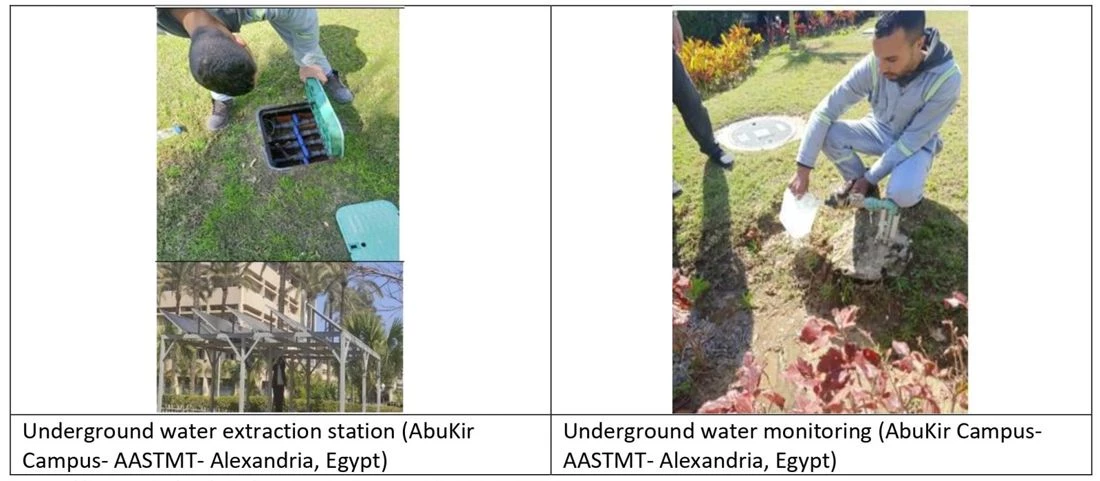
The underground water extraction station and monthly water monitoring that supply campus irrigation, Abu Qir.
At the Aquaculture Research Center, a greenhouse collects rain in ten tanks and grows plants with hydroponic and aquaponic systems that use up to 90% less water than traditional farming.
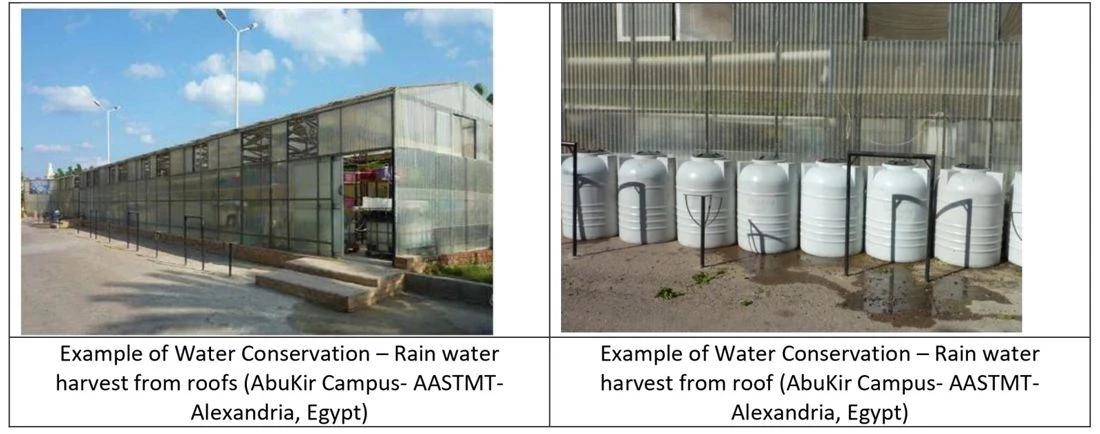
Rainwater harvested from the greenhouse roofs and stored in tanks, Abu Qir.
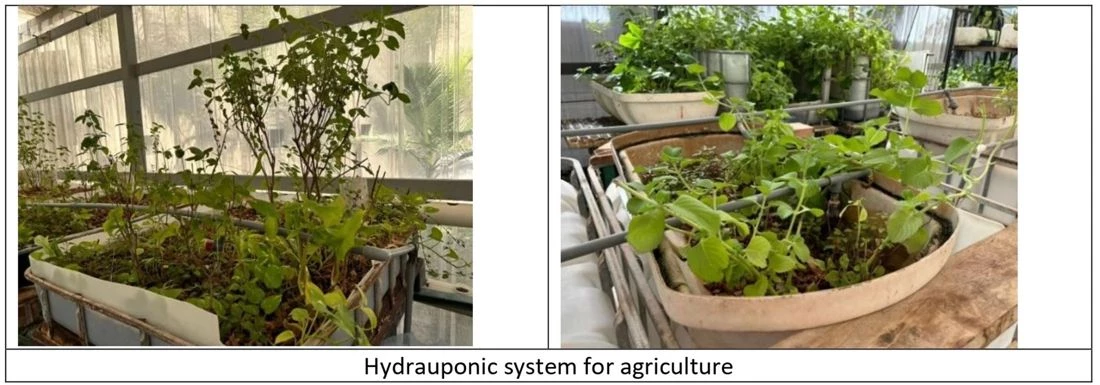
Hydroponic growing in the Aquaculture Research Center greenhouse, Abu Qir.
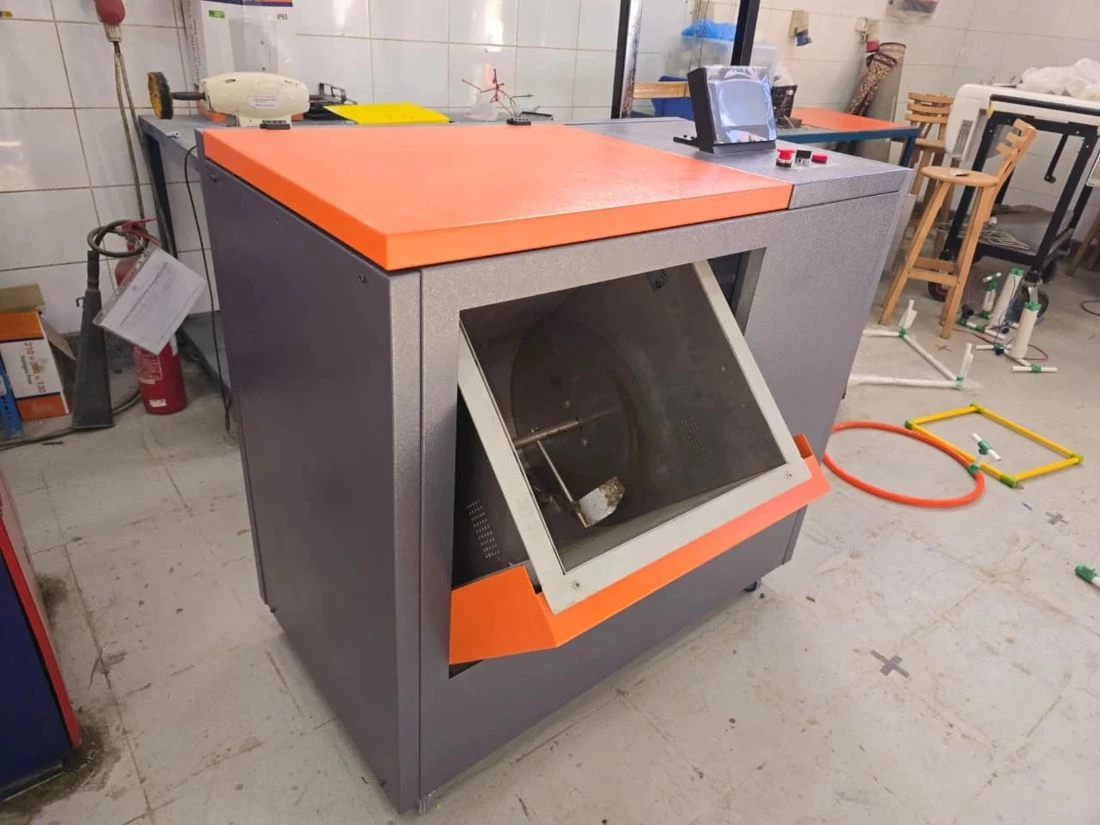
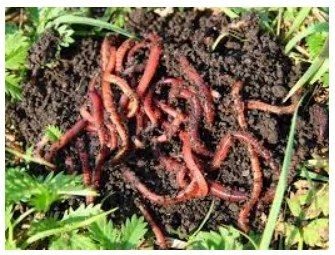
Food waste from campus kitchens goes into a composter unit that turns it into rich compost for the gardens, and a vermicomposting unit uses red wiggler earthworms (Eisenia fetida) to turn organic waste into nutrient-rich vermicompost. Healthier soil means healthier plants and fewer chemical fertilisers.
 |
 |
|---|---|
| The campus composter unit | Red wiggler earthworms making vermicompost |
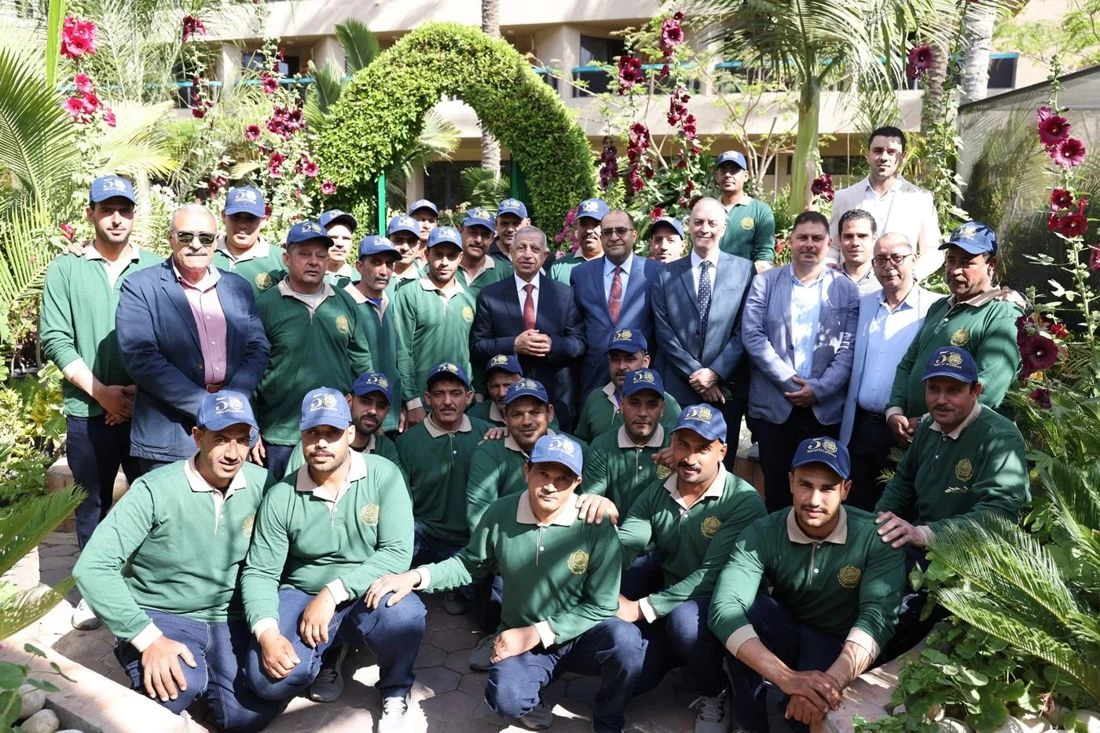
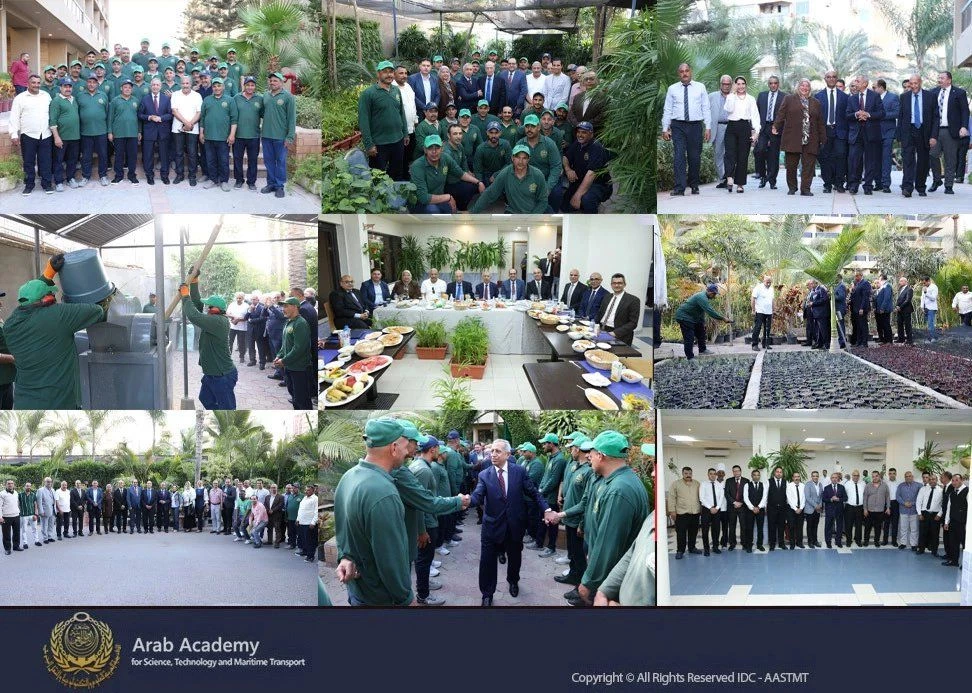
At the heart of the campus are AASTMT’s own planting nurseries, where staff raise and care for the plants used to extend the green areas. The nurseries and the plant expansion works are inspected each spring by the AASTMT President.
|
13 May 2024 · Abu Qir Campus Nurseries keep growing On 13 May 2024 the AASTMT President, Prof. Dr. Ismail Abdel Ghaffar, inspected the expansion of the planted areas and the latest technologies used to grow plants and nurture trees. Read more: AASTMT news, May 2024 |
|---|
|
12 May 2025 · Abu Qir Campus Better ways to care for plants On 12 May 2025 the AASTMT President, Prof. Dr. Ismail Abdel Ghaffar, toured the Abu Qir Campus planting nurseries, where staff presented their newest methods for plant maintenance and irrigation as the green areas of the campus continued to grow. Read more: AASTMT news, May 2025 |
|---|
 |
 |
|---|---|
| Nursery staff, May 2024 | Planting nurseries, May 2025 |
The lawns and trees of the Abu Qir Campus shelter birds such as crows. Two spreading ornamentals, creeping oxeye (Sphagneticola trilobata) and Mexican petunia (Ruellia simplex), known to be invasive in other regions, are watched and kept within managed beds under the AASTMT alien species policy.
The campus action plan sets out the next steps: mapping green cover in GIS, verifying every plant record, registering and protecting mature trees, planting more native and drought-adapted species, seasonal bird and pollinator surveys with students, integrated pest management, and an annual public update.
04 · South Valley Campus, Aswan · since October 2006
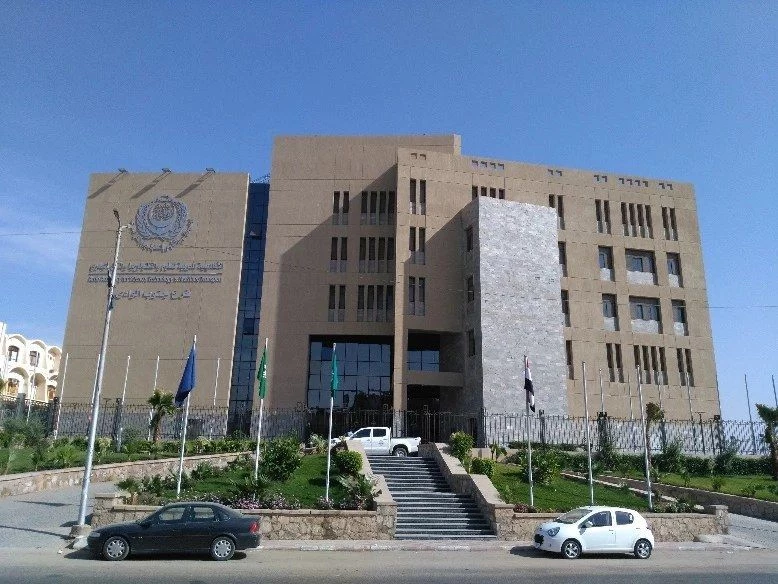
Aswan is one of the hottest cities on Earth. Summer days pass 45 °C and in July and August the air holds as little as 12% humidity. Here every plant counts, and our South Valley Campus and its researchers have made green walls, trees and desert land their field of study.
|
Oct 2006 first classes on the South Valley Campus |
3,250 m² campus building footprint |
4,765 m² of planted green walls |
6 °C cooler behind a planted green wall (2025 study) |
|---|
The AASTMT South Valley Campus in Aswan.
“On a 45 °C August day in Aswan, a green wall kept the rooms behind it up to 6 °C cooler.”
Field study by AASTMT South Valley Campus researchers, summer 2025 (submitted 19 Sep 2025, published 19 Jan 2026)
|
Published 10 May 2024 · South Valley Campus (El-Khazzan district, Aswan) Which trees cool a desert neighbourhood? Researchers measured the microclimate of the El-Khazzan residential district for 24 hours on one of the hottest days of the year, then modelled different mixes of grass and the tree species Cassia leptophylla, Cassia nodosa and Ficus nitida. Key figures District of 33,800 m², 13% built up. More trees lowered air temperature by up to 0.92 K; trees with grass lowered the felt temperature by 7.5 °C on average; 75% trees with 50% grass worked best. Published in: Sustainability (MDPI) |
|---|
|
Published 1 Sep 2024 · Wadi Dihmit, Eastern Desert, Aswan Water to bring desert land back to life Led by Shenouda Ghaly of the Civil Engineering Department at the AASTMT South Valley Campus, the team used satellite images, GIS and watershed models to map flash floods in Wadi Dihmit, the largest wadi in the Eastern Desert after Wadi Allaqi, and to choose a site for a dam that would store the water for reclaiming new farmland against desertification. Key figures 4,925 km² studied, 25 km south-east of the High Dam; more than 34% sandy and valley deposits suited to reclamation; modern irrigation and heat- and salt-tolerant crops recommended. Published in: Aswan University Journal of Environmental Studies |
|---|
|
Published 11 Sep 2024 · New Aswan City Shade trees for a campus courtyard AASTMT South Valley Campus architect Abdelaziz Farouk Mohamed tested nine planting designs for a courtyard in New Aswan City with a partner campus, using field monitoring and simulation. Key figures Planting 60% of the courtyard with the drought-adapted tree Cassia nodosa lowered the felt temperature by more than 25.4 °C and saved about 19.2% of cooling energy. Published in: Urban Science (MDPI) |
|---|
|
Published 31 May 2025 · South Valley Campus, Aswan Turning farm waste into cooler buildings Rania Emad Abd El-Hady of the AASTMT South Valley Campus mixed Aswan clay with mushroom-farm waste to make lighter bricks, giving a second life to an agricultural residue. Key figures At 15% waste the bricks conduct 62% less heat, and 45 cm walls cut annual cooling needs by 12.4%. Published in: Journal of Engineering and Applied Science |
|---|
|
Submitted 19 Sep 2025 (published 19 Jan 2026) · Nagaa Al Karur, Aswan Green walls on Aswan homes Mohab Taher Abdelfatah and Menatallah Assem Elkholy of the AASTMT South Valley Campus monitored a residential building hour by hour and compared its bare brick wall with a wall covered in climbing plants and a planted green wall with an air gap behind it. Key figures Outdoor peak 45.17 °C. Climbing plants: 1.55 °C cooler inside on average. Planted green wall: 3.59 °C cooler on average and up to 6.04 °C. Published in: Journal of Umm Al-Qura University for Engineering and Architecture |
|---|
|
Published 9 Sep 2025 · South Valley Campus, Aswan Gardens on the roof AASTMT architects compared extensive, semi-intensive and intensive green roofs on an educational building in Aswan, showing how planted roofs can bring vegetation to the top of buildings and keep classrooms cooler. Published in: Journal of Umm Al-Qura University for Engineering and Architecture |
|---|
The South Valley Campus sits close to some of Egypt’s most precious landscapes: the shores of Lake Nasser, the Wadi Allaqi Biosphere Reserve on its eastern bank, and the Nile islands of the Saluga and Ghazal Protected Area just south of the city. Working with these protected areas on surveys and restoration is the next chapter of our work in Aswan.
05 · North Coast · Matrouh
Our newest campus, the El Alamein Campus, stands in New Alamein, where the Mediterranean meets the Western Desert. It graduated its first class in August 2024 and is a place to study the plants of the coastal desert.
The AASTMT El Alamein Campus in New Alamein.
|
24 Aug 2024 · El Alamein Campus A first graduation on the North Coast The El Alamein Campus graduated its first class on 24 August 2024, in the presence of Arab League Secretary-General Ahmed Aboul Gheit and Minister of Higher Education Mohamed Ayman Ashour, representing the Prime Minister. Egypt’s Minister of Agriculture and Land Reclamation, Alaa Farouk, spoke of AASTMT’s role in educating young people and researchers; AASTMT lists the event among its SDG 15 actions. Read more: AASTMT news |
|---|
|
26 Oct 2024 · El Alamein Campus (El Dabaa farms) Learning from medicinal-plant farms Students of the AASTMT El Alamein Campus visited a medicinal-plant farm in El Dabaa, Matrouh, to see how plant species are grown, harvested and processed. Read more: AASTMT news |
|---|
|
Ongoing · El Alamein Campus Every drop for the land The campus is built with a rainwater drainage network and a hospital wastewater treatment unit, so that water can be safely reused for irrigation and kept out of natural water bodies. |
|---|
06 · Research from the Abu Qir Campus
AASTMT’s colleges at the Abu Qir Campus study ecosystems far beyond the campus: mangrove forests on the Red Sea, wetlands of the Nile Delta, city trees, and new technology to watch over forests and stop invasive plants.
| 30 Jul 2024 |
Blue carbon in grey mangroves. Carbon measured in the sediments and vegetation of Avicennia marina stands along Egypt’s Red Sea coast (Kareem Tonbol). |
|---|---|
| 17 Apr 2025 |
Moving green walls. Dynamic vertical green walls for teaching buildings in a Mediterranean city. Published in F1000Research |
| 4 Nov 2025 |
Listening to trees. Fibre-optic sensors in tree trunks and a drone-mounted spectrometer track forest health in real time (Port Training Institute). Published in IEEE Access |
07 · Research from greater Cairo
At the Heliopolis and Smart Village campuses, AASTMT researchers study how to protect desert plants, rebuild soils, plant trees where people need shade, and understand the world’s forests.
|
23 Sep 2024 · Heliopolis Campus (ceremony at the St Regis Almasa, New Administrative Capital) Partners for agricultural industries AASTMT President Prof. Dr. Ismail Abdel Ghaffar and MAFI founder Ahmed Abou Hashima signed a cooperation protocol linking the College of Management & Technology at the Heliopolis Campus with the agricultural produce industry, on the sidelines of the College’s graduation ceremony on Monday 23 September 2024. Read more: AASTMT news |
|---|
| 31 Jan 2024 |
Biochar from farm waste. Rice straw, sawdust, sugarcane and tree leaves turned into biochar to restore soils (W. Abbas, Osama M. Morsy). Published in Scientific Reports |
|---|---|
| 13 May 2025 |
Where to plant trees. AI-driven design to place trees for the best shade in hot, dry public spaces. Published in Scientific Reports |
| 8 Jul 2025 |
A biodiversity hotspot from space. Satellite analysis of water in Borneo’s forests (Mohammed Magdy Hamed). Published in Theoretical and Applied Climatology |
08 · Community and cooperation
Biodiversity is a shared task. Our students, staff and partners in Egypt and abroad have planted, studied and campaigned for nature.
|
3 May 2024 · Abu Qir Campus UniGreen: green businesses for climate and land Participants in the EU-funded UniGreen competition, led by the Life Makers Foundation with AASTMT, completed a six-day bootcamp at the Abu Qir Campus to turn local ideas into climate-focused businesses. AASTMT lists the bootcamp among its SDG 15 actions for land restoration and ecosystem protection. Key figures Six-day bootcamp; funded by the European Union. Read more: AASTMT news |
|---|
|
5–6 Jun 2024 · World Environment Day Green environment, green tourism For World Environment Day 2024 AASTMT organised an international workshop on green tourism and environmental protection with the Italian Cultural Institute and the Egypt Future Foundation, opened by AASTMT Vice President Dr. Alaa Abdel Bari. AASTMT presented its TouMaLi marine-waste project, UniGreen with the Life Makers Foundation, and Green Med. Read more: AASTMT news |
|---|
| Oct 2022 – Sep 2027 |
RURALITIES. A Horizon Europe project building climate-smart, ecosystem-enhancing rural training hubs across Africa and Europe; AASTMT receives €41,718.75. Horizon Europe project 101060876 |
|---|---|
| Apr 2024 – Mar 2027 |
Pro-GREEN-LABs. Joint urban labs on green competences with European and Egyptian partners, coordinated from Weimar, Germany. |
| Oct 2025 – Oct 2027 |
HEEFTA. Environmental education linking people and nature across six Mediterranean countries; AASTMT share €130,592. |
| Oct 2025 – Sep 2028 |
SAFER. Climate-resilient, sustainable farming in higher education. |
09 · Our commitments
The next five years will build on everything in these pages.
01 No net loss of green cover
Every new building and campus, including the Al Burouj and El Alamein campuses, will be planned to keep and extend its green spaces.
02 Plants from our own nurseries
The Abu Qir Campus nurseries will supply plants for the revegetation of all campuses.
03 Native and water-wise
New planting will favour native and drought-adapted species, irrigated only with groundwater, treated water and rain.
04 Watchful care
Mature trees will be registered and protected, and invasive plants monitored on every campus.
05 Restoring Egypt’s ecosystems
We will work with protected areas such as Wadi Allaqi and Saluga and Ghazal, and build on our mangrove research on the Red Sea coast.
06 Open reporting
We will publish an update on our campuses’ biodiversity every year.
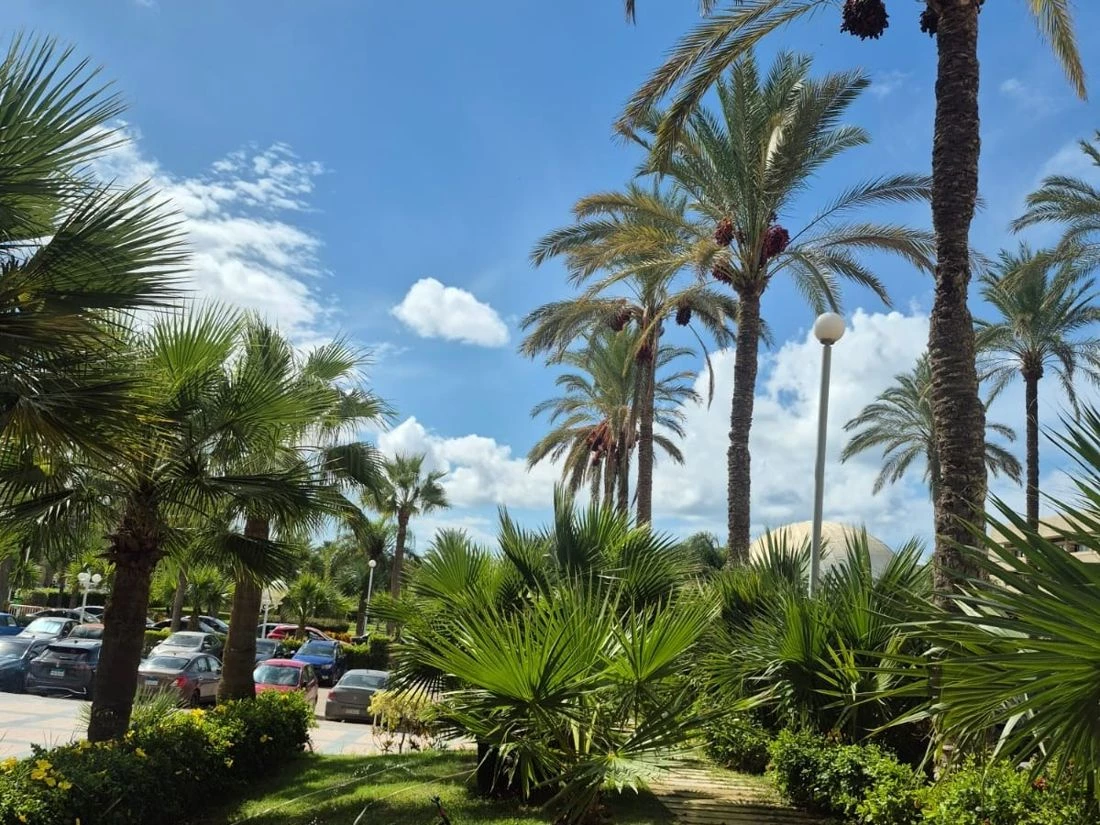
Palms, lawns and walkways at the Abu Qir Campus.
Reporting period: January 2024 – December 2025. Published by the Arab Academy for Science, Technology and Maritime Transport (AASTMT). Photographs: AASTMT.


