
AASTMT maintains green campuses on Egypt’s Mediterranean coast, at the desert edge of Cairo and in the hot desert of Aswan. At Abu Qir, its main campus, 62,000 m² is planted with vegetation, thirteen borehole wells irrigate the gardens, and organic waste is processed into soil conditioner and compost. The 2026 baseline recorded 23 plant taxa at Abu Qir.
This plan puts into practice the biodiversity commitments of AASTMT’s Environmental Sustainability Policy and its policies on IUCN Red List species and alien species (Section 4). It sets out ten action areas, a biodiversity review for every qualifying project, a development plan for each campus site through 2030 and indicators reported every year.
|
62,000 m² planted vegetation at Abu Qir (Environmental Sustainability Policy) |
13 borehole wells irrigating the Abu Qir gardens (Environmental Sustainability Policy) |
213,646 m² area of the main campus at Abu Qir (Environmental Sustainability Policy) |
8 campuses in Egypt covered by this plan, plus the Latakia branch |
The AASTMT Environmental Sustainability Policy (Version 6, last reviewed in 2026) commits AASTMT to maintain and extend the green areas and habitats of its campuses, protect threatened species, reduce the impact of alien species, and fight land degradation and desertification; its targets require every campus to be surveyed at least once a year from 2027. The AASTMT Policy for Identifying, Monitoring and Protecting IUCN Red List and National Conservation List Species (Egypt) and the AASTMT Policy for Reducing the Impact of Alien Species on Campus set out how AASTMT identifies, monitors and protects listed species and how it prevents, detects, removes and replaces invasive species. This plan turns those commitments into actions, responsibilities, procedures and targets for every campus site.
| Policy | Date | Relevant commitments | Implemented in this plan through |
|---|---|---|---|
| AASTMT Environmental Sustainability Policy (Climate, Ocean and Land) | Created January 2019; Version 6, last reviewed October 2026; next review 2029 | Commitment 3: maintain and extend the green areas and habitats of the campuses; protect threatened species; reduce the impact of alien species; fight land degradation and desertification. Life on Land actions: protect mature trees and favour native and drought-adapted species; survey and monitor campus biodiversity and contain and replace invasive alien species; conserve soil through compost and drip irrigation; plan every new building with local biodiversity in mind; work with communities and NGOs on afforestation and greening. Targets: every campus surveyed at least once a year from 2027; at least 70% native and drought-adapted species in new planting; non-potable share of campus water from 27.8% to 35% by 2028. |
Campus development plans: Section 12. Campus surveys and reporting: Actions 2 and 9; Section 13. Community partnerships and restoration: Action 8. Alien species management and awareness: Actions 3 and 10. Land conservation and restoration: Actions 5 and 6. Native planting: Actions 5 and 7; Section 13. Biodiversity in project planning: Action 1; Sections 8 and 10. Mature trees: Action 4. Non-potable water target: Action 5; Section 13. |
| AASTMT Policy for Identifying, Monitoring and Protecting IUCN Red List and National Conservation List Species (Egypt) | created August 2024; Version 3, reviewed October 2026; next review 2028 | Covers the eight campuses in Egypt, training ships and field sites. Keep a species register for every campus, updated yearly, with registers for all eight campuses by 2027; check new building, landscaping and lighting projects for threatened species before they start; run spring and autumn bird counts on the coastal campuses (two a year at Abu Qir and El Alamein) and yearly plant, pollinator and wildlife surveys; protect habitats with buffer zones and protected mature trees; report injured or caught protected animals within 24 hours; publish a yearly monitoring summary from 2027. | Actions 1, 2 and 9; project review in Section 8; indicators in Section 13. |
| AASTMT Policy for Reducing the Impact of Alien Species on Campus | In place: academic year 2024–2025; reviewed October 2026; next review 2028 | Covers the eight campuses in Egypt, their nurseries, water bodies, laboratories and training ships. Inspect plant, soil and compost deliveries; plant from an approved list favouring native and drought-adapted species; survey plants yearly and trees and palms every season; remove new invasive species within 30 days; contain established invasive ornamentals and replace them with native species by 2028; apply integrated pest management; replant from a verified native short list; teach biosecurity; publish a yearly alien species summary from 2027. | Actions 3 and 7; awareness under Action 10; campus measures in Section 12; reporting under Action 9; indicators in Section 13. |
| Item | Value | Source |
|---|---|---|
| Total campus area | 213,646 m² | Environmental Sustainability Policy, Section 4 |
| Planted vegetation | 62,000 m², about 30% of the campus | Environmental Sustainability Policy, Section 4 |
| Irrigation | Thirteen borehole wells irrigate the Abu Qir gardens | Environmental Sustainability Policy, Section 4 |
| Groundwater abstraction, academic year 2025–2026 (latest Facilities record) | 85,099 m³ in total, recorded monthly (1 July 2025 – 30 June 2026) | AASTMT Facilities statement of groundwater consumption, 2025–2026 |
| Organic waste processing, academic year 2025–2026 (latest Facilities record) | The Facilities statement reports 35 t of agricultural waste recycled and lists 20 t of organic soil conditioner (shredded tree leaves mixed with sawdust) and 15 t of compost (shredded palm fronds and leaves mixed with sawdust), used on campus plants, palms and green areas. It does not state whether the 35 t is the waste input or the total of the two products. | AASTMT Facilities statement, 1 July 2025 – 30 June 2026 |
| Biodiversity baseline (2026) | The Environmental Sustainability Policy reports 23 plant taxa recorded in the 2026 baseline at Abu Qir. The baseline recorded two ornamentals that are invasive in other regions, creeping oxeye (Sphagneticola trilobata) and Mexican petunia (Ruellia simplex), in flower beds; both are on the alien species watch list. A full survey of plants, birds and pollinators is scheduled under Action 2. | Environmental Sustainability Policy, Section 4; AASTMT Policy for Reducing the Impact of Alien Species on Campus, watch list |
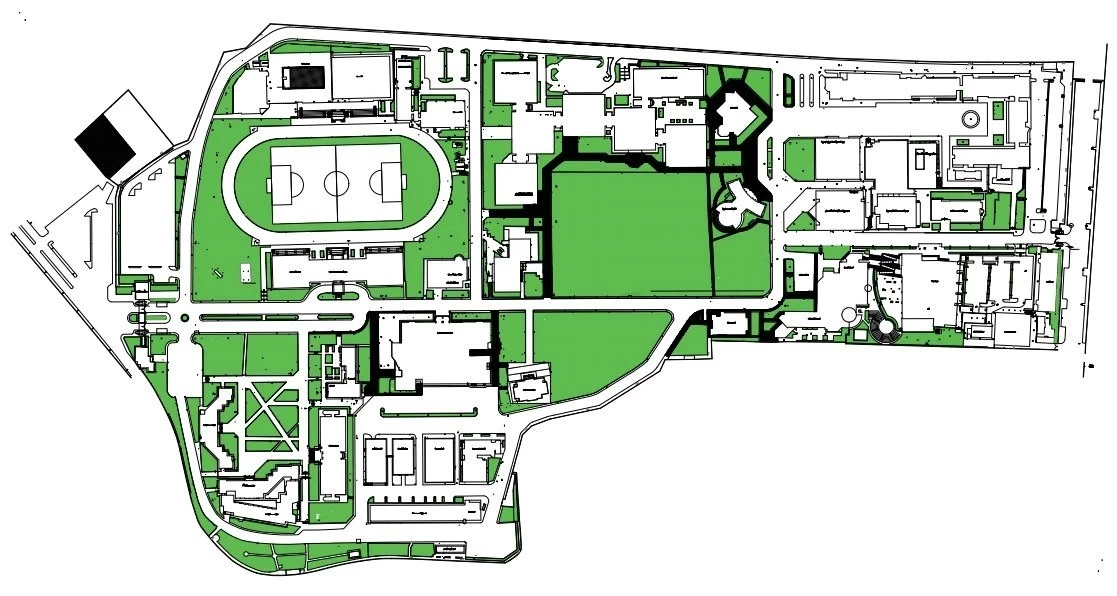
Map of planted vegetation (green) on the Abu Qir campus.
| Campus site | Setting | Recorded features | Sensitivities to confirm by survey |
|---|---|---|---|
| Alexandria | Mediterranean coast and city | Gardens, palms and planting nurseries at Abu Qir, irrigated from 13 borehole wells | Migratory birds on the coastal flyway, including steppe eagle and saker falcon (IUCN species policy); established trees and palm groves |
| Cairo and Giza (Heliopolis, Dokki) | Dense city | Urban campuses at Heliopolis (Cairo) and Dokki (Giza) | Existing trees and courtyard planting |
| Smart Village | Desert edge | Campus within the Smart Village business park, Giza | Desert soils and drought-adapted plants |
| El Alamein | Coast and Western Desert | Hospital and laboratory wastewater treated on site and reused for irrigation, toilet flushing and cleaning; campus rainwater conveyed to the New Alamein network, which reuses it for irrigation (wastewater discharge guidelines) | Coastal habitats and existing vegetation; Egyptian tortoise: targeted habitat survey of undeveloped coastal desert by a specialist |
| Port Said (Port Fouad) | Mediterranean coast at the Suez Canal | Campus at Port Fouad on the Suez Canal | Waterbirds of the Lake Manzala wetland and the coastal flyway; lighting and glazing near open water |
| Aswan South Valley | Hot desert of the Nile Valley | Planting basins and shaded walkways, built with the campus building in 2015/2016 (construction standards, November 2025) | Desert vegetation; Egyptian vulture: check new power lines and lighting for collision and electrocution risk |
| Latakia | Mediterranean coast, Syria | Branch campus in Latakia, Syria | Coastal Mediterranean vegetation and birds; to be established in the branch baseline (Section 12) |
Objective: to conserve, restore and use sustainably the terrestrial ecosystems associated with AASTMT campuses and operations; to include local biodiversity in every campus development decision; to protect listed species; to manage alien species according to risk; and to work with authorities and local communities on shared land ecosystems.
| Action Item | Responsible Party | Timelines | Performance Indicator | Resources Required |
|---|---|---|---|---|
| 1. Project biodiversity review: Every qualifying project (Section 3) must follow the biodiversity review procedure in Section 8 and have a completed, signed Biodiversity Statement before tender approval. Until the Biodiversity Statement template is issued, a procedure introduced by this plan applies: the SDG 15 officer completes the Section 8 review and records it in a signed screening note, which the SDGs Workforce Committee approves before tender approval. | SDG 15 officer; Sustainability Office; Construction Administration; SDGs Workforce Committee | Each project from November 2026; screening notes until the template is issued; template prepared by the Sustainability Office and issued by the SDGs Workforce Committee by June 2027 | Qualifying projects approved for tender with a Biodiversity Statement or screening note (%) | Survey time of SDG 15 officer and colleges |
| 2. Listed species: Identify listed species on sites and in affected areas; monitor them each year; protect them through buffer zones, design or location changes, timing of works and control of lighting and runoff; report records to the competent authorities. Run two seasonal bird counts a year, in spring and autumn, at Abu Qir and El Alamein; report injured, stranded or caught protected animals to the Sustainability Office within 24 hours. Surveys use fixed plots or transects and bird point counts, repeated in the same seasons with effort recorded, and records are verified by AASTMT scientists. | SDG 15 officer with the colleges | Baseline surveys at Abu Qir and El Alamein by June 2027; species register for every campus by December 2027; annual surveys at every campus from 2027 | Campus sites surveyed; listed species records reported | Field survey kits; student surveyors |
| 3. Alien and invasive species: Inspect incoming plants, soil and compost; survey campus plants annually and trees and palms seasonally. Remove newly detected invasive species within 30 days. Contain creeping oxeye and Mexican petunia, prevent further planting and spread, and progressively replace them with suitable native plants by 2028. Apply integrated pest management and dispose of invasive material safely to prevent regrowth. | Facilities and Maintenance; AASTMT Planting Nurseries | Annual plant surveys and seasonal tree and palm inspections; newly detected invasive species removed within 30 days of detection; progressive replacement of creeping oxeye and Mexican petunia completed by 2028. | Alien species assessed; invasive species with a management plan | GIS mapping; nursery screening |
| 4. Compensation for unavoidable loss: replace each mature tree that cannot be retained with at least three trees of suitable native species on the same campus, replanting losses so that at least 80% survive at three years; compensate for any loss of habitat separately, by area and condition. Basis: Environmental Sustainability Policy, Life on Land actions: protect mature trees; the replacement ratio and survival rate are measures of this plan. | Construction Administration; Facilities and Maintenance | Each project from November 2026; survival checks one and three years after planting | Compensation ratio; survival at three years | Nursery stock |
| 5. Native, water-wise landscapes: Use native and drought-adapted species for at least 70% of new planting, with drip or perforated-pipe irrigation supplied by suitable non-potable water. Monitor groundwater quality quarterly, including electrical conductivity, and soil salinity annually; report results from 2027. Verify groundwater-abstraction authorisations at Abu Qir and track progress towards the policy target of 35% non-potable water use by 2028. | Facilities and Maintenance | All new planting from November 2026; groundwater analyses reported from 2027; licence confirmed by December 2027 | Native and drought-adapted species in new planting (%) (target at least 70%); irrigation by source; groundwater quality recorded | Irrigation network upgrades |
| 6. Conserve and restore campus land: Map habitats in GIS; add NDVI monitoring of vegetation cover; restore degraded land; protect topsoil; return organic waste to the soil. Basis: Environmental Sustainability Policy, Life on Land actions: conserve soil through compost and drip irrigation; Commitment 3: fight land degradation; NDVI monitoring recommended by the Campus Land Sustainability Change Detection Report. | Facilities and Maintenance | GIS map of Abu Qir by December 2027; then updated yearly | Habitat area and condition; organic waste returned to the soil | GIS software; composting units |
| 7. Native species nurseries: Propagate native species for campus revegetation, starting with the verified short list of native and drought-adapted species in the alien species policy; record the number of plants propagated and the share of native species. | AASTMT Planting Nurseries | Propagation records from the 2027 planting season | Plants propagated (number); native species (%) | Seed and nursery materials |
| 8. Shared land ecosystems: Collaborate with local communities and the relevant authorities or landowners to protect, maintain and, where appropriate, restore land ecosystems in areas near or affected by AASTMT campuses and activities. Document each collaboration, including the community’s contribution, the activities undertaken and their outcomes. | SDG 15 officer; branch administrations | At least once a year; first collaboration documented under this plan by December 2027 | Collaborations completed and published | Partnership and transport costs |
| 9. Monitoring and reporting: Baseline for each campus site; biodiversity monitoring system; annual report on the AASTMT website, which includes the yearly summaries of species monitoring and of alien species required by the IUCN species and alien species policies. | SDG 15 officer | First annual report by December 2027; then annually | Annual report published | Staff time |
| 10. Awareness and engagement: One planting, survey or restoration activity per campus site each year; alien species and biosecurity awareness in orientation. Basis: Environmental Sustainability Policy: land topics in every programme and in student orientation; alien species policy: teaching on invasive species and biosecurity. | Colleges; SDG 15 officer | Annually, from academic year 2026–2027 | Activities and participants | Event materials |
| Stage | Requirement | Responsible |
|---|---|---|
| 1. Site selection | Prefer previously developed land. Avoid protected areas, wetlands, dunes and habitats of listed species | Construction Administration |
| 2. Baseline survey | Map trees, green cover, species, soil and water. Check against the IUCN Red List, national lists and the invasive species watch list | SDG 15 officer with the colleges and Facilities and Maintenance |
| 3. Design | Keep mature trees and green corridors. Minimise the footprint. Use native planting. Retain rainwater on site. Use shielded lighting | Designers and consultants |
| 4. Approval | Biodiversity Statement, using the template to be issued by the SDGs Workforce Committee (Action 1), completed before tender; until the template is issued, a signed screening note by the SDG 15 officer. No approval for a net loss of biodiversity; until the Section 6 method is adopted, no loss of habitat area or of a mature tree that could be retained | SDGs Workforce Committee |
| 5. Construction | Tree protection zones. Topsoil reuse. Pre-clearance checks; no tree or shrub removal during the bird breeding season, as set by the SDG 15 officer, unless a check on the same day confirms there are no active nests. Control of dust, runoff and waste | Contractors, supervised by the Construction Administration |
| 6. Restoration | Native replanting. Apply Action 4 | Facilities and Maintenance; AASTMT Planting Nurseries |
| 7. Follow-up | Survey at one and three years after completion | SDG 15 officer |
In November 2025 the Construction Administration issued the AASTMT standards for constructing, operating and maintaining buildings. They require planting basins at building sites, planting of vacant land with trees, shrubs and local plants, perforated-pipe instead of flood irrigation, and directing rainwater to the soil. They do not require a biodiversity survey before design; Section 8 introduces that step. From November 2026, projects also apply: native species first; screening of plant stock for invasive species; protection zones around mature trees; shielded lighting; and bird-safe glazing near water or open habitat. No untreated wastewater or hazardous material is discharged to soil or habitats, under the AASTMT Standards and Guidelines for Discharge of Wastewater.
This section records dated campus practice. Items dated in academic year 2024–2025 or calendar year 2025 are: the Climb2Change collaboration in Wadi Degla Protected Area (November 2024); the Think Tank building (built 2024/2025); and the construction standards issued in November 2025. The satellite comparison of campus land uses imagery from 2022 and 2025. The nursery visit of May 2024 is earlier practice. The organic waste figures (2025–2026), the vermicomposting unit (2026) and the PRO-GREEN LABS workshop (September 2026) are later practice. The Biodiversity Statement procedure in Section 8 applies to projects from November 2026.
| Item | Period | What was done or recorded | Source |
|---|---|---|---|
| Campus land change | Imagery of 2022 and 2025 | The AASTMT Campus Land Sustainability Change Detection Report compares satellite imagery of the Abu Qir campus from 2022 and 2025. It reports no significant loss of green zones inside the campus boundary and states that new buildings were placed in previously disturbed or planned development zones. It recommends NDVI monitoring of vegetation as a next step. | AASTMT Campus Land Sustainability Change Detection Report |
| Organic waste | July 2025 – June 2026 | The Facilities statement reports 35 t of agricultural waste recycled and lists 20 t of organic soil conditioner (shredded tree leaves mixed with sawdust) and 15 t of compost (shredded palm fronds and leaves mixed with sawdust), used on campus plants, palms and green areas. It does not state whether the 35 t is the waste input or the total of the two products. | AASTMT Facilities statement, 1 July 2025 – 30 June 2026 |
| Vermicomposting unit, Abu Qir | Photographed in 2026 | A closed vermicomposting unit uses compost worms to turn organic waste into vermicompost for campus planting. Quantities will be reported under Action 6. | AASTMT photographs, 2026 |
| Presidency annex hall (“Think Tank”), Abu Qir | Built 2024/2025 | Repurposing of the hall attached to the AASTMT Presidency building, with many planting basins in the surrounding site and in the main corridors and staircase patio. These are greening features of the design; a biodiversity survey before design is required for future projects under Section 8. | AASTMT standards for constructing, operating and maintaining buildings, November 2025 |
| Planting nurseries, Abu Qir | 12 May 2024 (earlier practice) | The AASTMT President toured the planting nurseries and the plant expansion works at Abu Qir on Sunday 12 May 2024 and met the nursery staff. A later news item, dated 12 May 2025, describes the same visit and the presentation of recent methods for plant maintenance and irrigation. | AASTMT news items dated 13 May 2024 and 12 May 2025 |
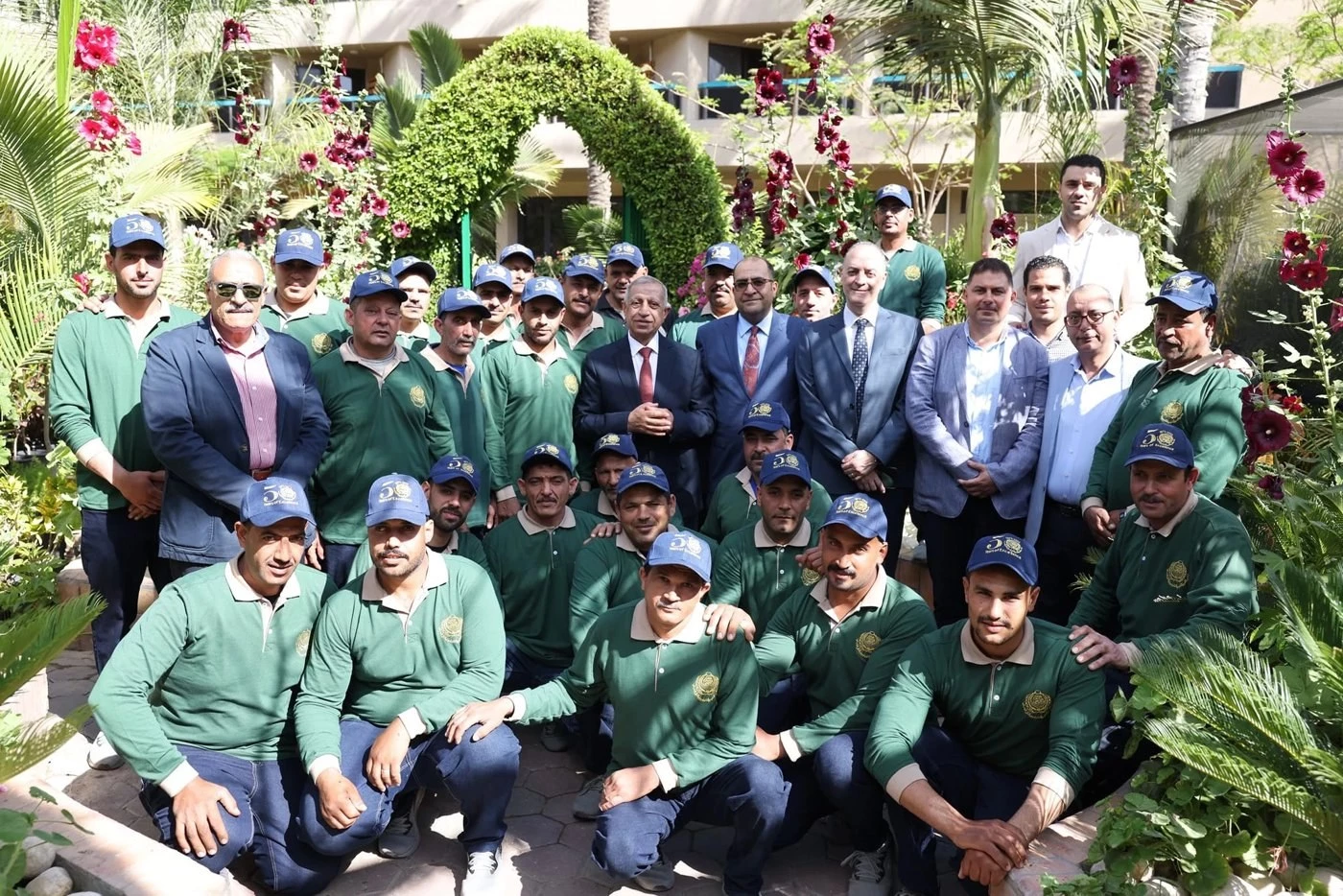
AASTMT Planting Nurseries staff, Abu Qir, May 2024.
| Activity | Date | Ecosystem | Partners | What was done |
|---|---|---|---|---|
| Climb2Change Egypt, Wadi Degla Protected Area | November 2024 (academic year 2024–2025) | Desert protected area | AASTMT College of Language and Media – Heliopolis (leadership and students), within a mission organised by Mashreq Bank under the patronage of the Ministry of Environment, with Nahdet Misr and volunteers from schools, universities and the local community | In November 2024, AASTMT staff and students from the College of Language and Media – Heliopolis participated in the Climb2Change clean-up at Wadi Degla Protected Area. AASTMT’s participation was launched by the Vice President for Postgraduate Studies and Scientific Research and the Dean of the College. Participants joined school, university and local community volunteers in collecting and sorting waste to help protect the desert ecosystem. |
| PRO-GREEN LABS, Al-Khalifa district, Cairo | September 2026 | Urban green space in a historic district | Local communities; Bauhaus-Universität Weimar | AASTMT was a partner in the PRO-GREEN-LABs Cairo International School, held on 3–9 April 2026 and focused on Al-Khalifa’s regeneration. Activities included field analysis, digital documentation and collaborative design proposals addressing greening, heritage preservation and community-oriented development. |
| Campus site | In place | Next step | Lead |
|---|---|---|---|
| Alexandria (Abu Qir) | 62,000 m² of planted vegetation irrigated from 13 borehole wells (Environmental Sustainability Policy, Section 4); AASTMT Planting Nurseries, toured by the AASTMT President on 12 May 2024 (AASTMT news); organic waste processed into soil conditioner and compost (AASTMT Facilities statement, 2025–2026) | Verify the 2026 plant record and complete a full baseline survey by June 2027; contain the two watch-list species in managed beds, then replace them with native species by the end of 2028; map green cover in GIS; register and protect mature trees; plant more native and drought-adapted species; spring and autumn bird counts and yearly plant and pollinator surveys, with students; increase planted vegetation, with the target set by December 2027 after GIS mapping | Facilities and Maintenance; AASTMT Planting Nurseries; SDG 15 officer |
| Alexandria (Miami, with the Wabour El-Maya and Janaklis sites) | Miami campus with the Wabour El-Maya and Janaklis sites | Baseline survey in 2027; branch biodiversity and green space plan by June 2028 | Branch administrations; SDG 15 officer |
| Cairo (Heliopolis) and Giza (Dokki) | Partner in Pro-GREEN-LABs with Bauhaus-Universität Weimar; community greening workshop in the Al-Khalifa district, Cairo (September 2026) | Baseline survey in 2027; branch biodiversity and green space plan by June 2028 | Branch administration; SDG 15 officer |
| Smart Village | Campus within the Smart Village business park, Giza | Baseline survey in 2027; branch biodiversity and green space plan by June 2028 | Branch administration; SDG 15 officer |
| El Alamein | On-site treatment and reuse of hospital and laboratory wastewater; rainwater reused for irrigation through the New Alamein network (wastewater discharge guidelines) | Plan the campus to keep and extend its green spaces; baseline survey by June 2027 (Action 2); branch biodiversity and green space plan by June 2028 | Branch administration; Construction Administration; SDG 15 officer |
| Port Said (Port Fouad) | Campus at Port Fouad on the Suez Canal | Baseline survey in 2027; spring and autumn waterbird counts from 2028; branch biodiversity and green space plan by June 2028 | Branch administration; SDG 15 officer |
| Aswan South Valley | Planting basins and shaded walkways, built with the campus building in 2015/2016 (construction standards, November 2025) | Assess the conceptual green-wall design for the campus building published in 2022; work with the Saluga and Ghazal Protected Area at Aswan and, further south, the Wadi Allaqi Biosphere Reserve on surveys and restoration; baseline survey in 2027; branch biodiversity and green space plan by June 2028 | Branch administration; SDG 15 officer |
| Latakia | Branch campus in Latakia, Syria | Baseline survey in 2027; branch biodiversity and green space plan by June 2028 | Branch administration |
| Indicator | Baseline | Target | Frequency |
|---|---|---|---|
| Qualifying projects approved for tender with a Biodiversity Statement or interim screening note (%) | New indicator | 100% | Each project |
| Habitat area and condition | GIS habitat map of Abu Qir by December 2027 | No net loss | Yearly |
| Planted vegetation, Abu Qir | 62,000 m² | Numerical target to be established by December 2027 following GIS mapping | Yearly |
| Plant taxa recorded, Abu Qir | 23 taxa of all origins (2026 baseline, Environmental Sustainability Policy) | Target for native plant taxa to be established by December 2027 following the first full survey cycle | Yearly |
| Campus biodiversity surveys | Campuses surveyed (of eight): first surveys in 2027, starting with Abu Qir and El Alamein baselines by June 2027 | All eight campuses in Egypt surveyed at least once a year from 2027; spring and autumn bird counts at Abu Qir and El Alamein; Latakia branch baseline in 2027, reported separately | Yearly |
| Native and drought-adapted species in new planting (%) | New indicator: share of plants, by number, in each season’s new planting that are native or drought-adapted species; first reported in the 2027 annual report | At least 70% | Each planting season |
| Alien species assessed; invasive species with a management plan | Two species on the alien species watch list (2026) | Local risk assessment of both; all recorded invasive species managed; newly detected invasive species removed within 30 days; both watch-list ornamentals progressively replaced by the end of 2028 | Yearly |
| Compensation and survival | New indicator | At least 3 native trees per mature tree removed; at least 80% survival at three years | Yearly |
| Non-potable share of campus water (groundwater and harvested rain) | 27.8% (Environmental Sustainability Policy, Section 4) | 35% by 2028 (policy target) | Yearly |
| Green areas irrigated from groundwater, Abu Qir | Abu Qir gardens irrigated from 13 borehole wells (Environmental Sustainability Policy, Section 4) | Maintain non-potable irrigation at Abu Qir; establish a measurable expansion target for other campuses by December 2027 | Yearly |
| Agricultural waste recycled on campus (t, as reported by Facilities) | 35 t, listed as 20 t soil conditioner and 15 t compost (academic year 2025–2026; input and output not separated) | Input and output tonnes reported separately from 2027; annual target set by December 2027 | Yearly |
| Collaborations with local communities on terrestrial ecosystems | Academic year 2024–2025: Climb2Change, Wadi Degla Protected Area, November 2024 (Section 11.2) | At least one a year (Action 8) | Yearly |
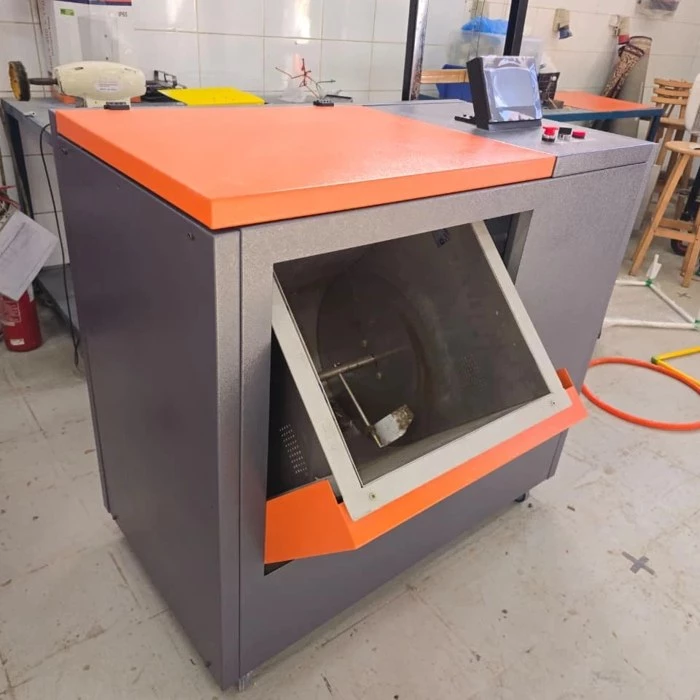 The campus composter unit, Abu Qir |
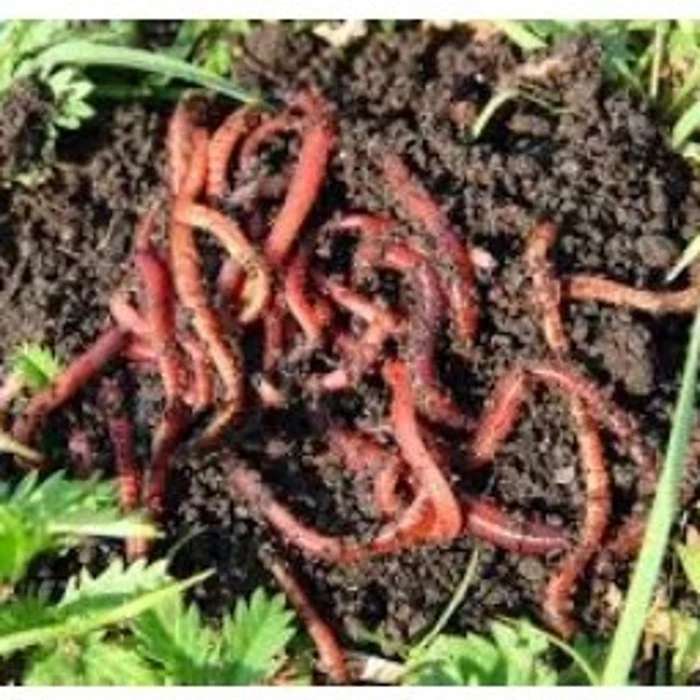 Compost worms making vermicompost |
For sites in Egypt: Environment Law No. 4 of 1994; Law No. 102 of 1983 on Natural Protectorates; the Egyptian Biodiversity Strategy and Action Plan 2015–2030; Egypt Vision 2030. For the Latakia branch: the national legislation in force there. Internationally: the Kunming-Montreal Global Biodiversity Framework and UN Sustainable Development Goal 15, Life on Land. AASTMT policies applied through this plan: the AASTMT Environmental Sustainability Policy; the AASTMT Policy for Identifying, Monitoring and Protecting IUCN Red List and National Conservation List Species (Egypt); the AASTMT Policy for Reducing the Impact of Alien Species on Campus; and the AASTMT Standards and Guidelines for Discharge of Wastewater.
| Item | Detail |
|---|---|
| Document title | AASTMT Biodiversity Action Plan and Campus Development Plan 2025–2030 |
| Owner | SDGs Workforce Committee (approving body), through the SDG 15 officer and the Sustainability Office |
| Applied by | Facilities and landscape departments, the Abu Qir planting nurseries, the College of Fisheries and Aquaculture Technology and the College of Maritime Transport and Technology |
| In place | Approved in academic year 2024-2025 |
| Reviewed | 2026 |
| Next review | 2027, and earlier if a new invasive species is found on campus |
| Approval signature | Dean of Scientific Research and Innovation |


